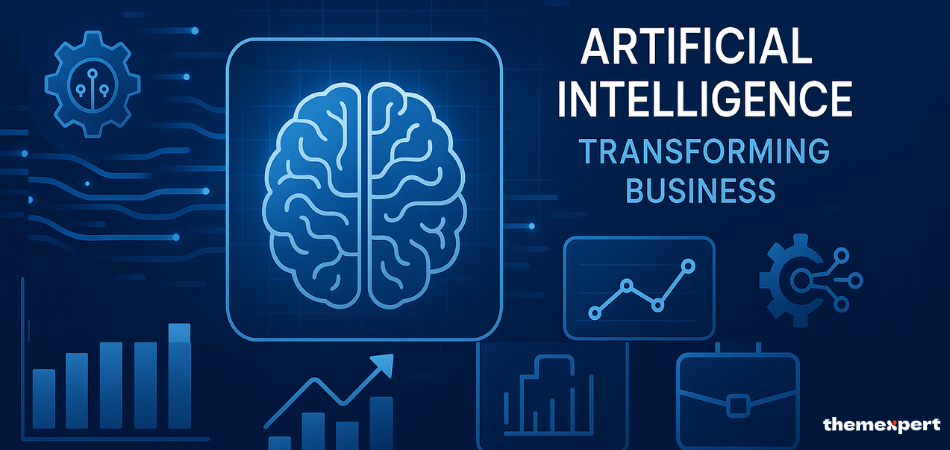
Artificial Intelligence, commonly known as AI, is no longer a futuristic idea. It has evolved into a transformative force that is fundamentally reshaping how companies operate, grow, and deliver value.
Across every sector, from manufacturing and finance to healthcare and retail, AI for business is becoming a vital ingredient for long-term success.
Companies are no longer asking whether to adopt AI but how to deploy it strategically. With accessible platforms, smarter algorithms, and growing enterprise experience.
AI for business is not just accelerating processes; it is driving innovation, enhancing customer engagement, and redefining the future of work.
The AI-Driven Business Landscape in 2025
AI for business has moved beyond experiments and proofs of concept. Organizations are now deploying AI systems that directly impact productivity, decision-making, and innovation.
AI is being used not only to automate but also to augment human capabilities. Rather than replacing people, it enables them to focus on high-value and creative work.
Businesses that embed AI into their operations are enjoying improved efficiency, stronger customer loyalty, faster product development, and more informed decision-making.
Let us explore how AI for business is changing the landscape across major operational pillars.
Hyper Automation of Routine Work
One of the most visible impacts of AI for business is the automation of repetitive tasks. More than 50 percent of back-office processes are now handled by intelligent systems.
These include robotic process ai tools for business automation combined with AI models that can read, interpret, and respond.
Examples of AI Automation
-
Automated invoice processing and data entry
-
AI-assisted payroll management
-
Compliance monitoring and reporting
-
Document scanning, summarizing, and classification
By implementing hyper automation, companies reduce costs, eliminate human error, and accelerate service delivery.
Employees, freed from mundane work, can shift their attention to strategic and analytical tasks. This shift increases overall job satisfaction and productivity.
Intelligent Customer Experience
In 2025, delivering a personalized and seamless customer experience is critical. AI for business is helping organizations achieve this by understanding customer behavior, predicting needs, and personalizing every interaction.
Key Applications
-
AI-powered chatbots now handle more than 90 percent of customer queries across industries
-
Virtual assistants provide round-the-clock service and support in multiple languages
-
Recommendation engines suggest products based on browsing and purchase history
-
Sentiment analysis tools adapt messaging based on customer mood and tone
The result is higher customer satisfaction, greater retention, and significant growth in revenue. Companies using AI to personalize interactions report sales increases of up to 25 percent.
Data-Driven Decision Making
AI is helping leaders make better decisions by providing actionable insights from vast data sources. Instead of relying on intuition or outdated reports, executives now use AI to guide real-time strategy.
Capabilities
-
Predictive analytics for demand forecasting and risk management
-
Decision intelligence platforms that recommend optimal business actions
-
Generative AI that simulates future scenarios and outputs alternatives
By 2025, around 70 percent of enterprises rely on AI-supported decision-making systems. These tools improve the speed, accuracy, and confidence of high-stakes choices.
They also reduce errors and help organizations stay ahead of shifting market dynamics.
Workforce Transformation
AI for business is not just about machines replacing people. It is about empowering the workforce.
As automation takes over routine work, human roles are evolving. Demand is growing for skills in data analysis, model training, ethics, and AI strategy.
Shifting Job Roles
-
Data scientists and AI engineers are now central to business innovation
-
Prompt engineers craft and optimize inputs for language models
-
Operations teams manage the deployment and oversight of AI systems
-
Digital ethics officers monitor responsible use and bias prevention
Companies report up to 20 percent gains in workforce productivity. Employees feel more fulfilled because their time is spent on meaningful, creative, and high-impact work.
Forward-thinking organizations invest in training and reskilling programs to stay competitive in this new landscape.
Enhanced Cybersecurity
Cyber threats are more advanced and persistent than ever before. AI for business plays a critical role in defending systems and data from evolving risks.
AI in Cyber Defense
-
Real-time monitoring tools detect suspicious behavior and anomalies
-
Machine learning algorithms predict threats before they occur
-
Automated response systems isolate breaches and activate containment protocols
-
Fraud detection tools prevent malicious transactions and phishing attacks
By 2025, about 85 percent of cybersecurity solutions include AI components. These systems minimize the risk of financial and reputational damage.
Businesses using AI-enhanced security save billions by preventing incidents and ensuring compliance.
Predictive Maintenance and Smarter Supply Chains
AI for business is revolutionizing physical operations as well. In manufacturing, logistics, and utilities, predictive maintenance prevents breakdowns and reduces downtime.
In supply chain management, AI improves accuracy and agility.
Operational Applications
-
Predictive algorithms assess equipment health and alert teams before failures
-
Inventory systems adjust stock levels based on real-time demand forecasting
-
Route optimization engines improve delivery efficiency and reduce fuel use
These technologies cut costs, improve performance, and reduce environmental impact.
Companies that adopt AI in operations see gains in reliability, speed, and customer satisfaction.
Accelerated Innovation
AI is now a tool for innovation, not just optimization. In 2025, companies use AI to create new products, test ideas, and improve user experiences faster than ever.
Innovation Boosters
-
Generative AI creates product prototypes and design variations
-
AI-assisted writing and media tools support marketing and communication
-
Multimodal systems combine text, image, video, and voice to create immersive applications
This acceleration of creativity leads to shorter development cycles, faster time to market, and deeper customer engagement. AI for business enables rapid testing and iteration, reducing the cost and risk of innovation.
Emerging AI Trends in 2025
Several cutting-edge trends are influencing how AI for business continues to evolve:
| Trend | Description | Impact |
|---|---|---|
| Multimodal AI | Understands multiple data types including text, audio, video, and images | Richer insights and intuitive user experiences |
| Agentic AI | AI agents autonomously manage tasks and workflows | Improved efficiency and employee support |
| Real-Time Personalization | Adapts digital experiences instantly based on user behavior | Enhanced engagement and satisfaction |
| Decision Intelligence | Combines AI with business logic and analytics | Smarter and faster decision-making |
| AI-Enhanced Cybersecurity | Real-time threat response and predictive defense | Reduced vulnerability and lower financial risk |
These trends show that AI for business is becoming more human-aware, adaptive, and intelligent. Businesses that adopt these innovations early gain a competitive edge.
Strategic AI: More Than Just a Tool
To fully benefit from AI, organizations must go beyond technical implementation. AI for business should be integrated into strategy, culture, and processes.
Key Considerations
-
Align AI with core business goals such as growth, efficiency, or customer success
-
Develop clear governance structures to manage AI use, data quality, and ethics
-
Involve cross-functional teams including IT, operations, compliance, and HR
-
Invest in continuous learning and adaptation as technology and needs evolve
The most successful companies treat AI as a strategic capability rather than a one-time project. They focus on long-term transformation, not short-term automation.
Ethics, Privacy, and Compliance
With power comes responsibility. AI for business must be deployed in ways that are ethical, transparent, and respectful of individual rights.
Responsible AI Practices
-
Regularly audit models for fairness, bias, and accuracy
-
Ensure data privacy by complying with regulations like GDPR and CCPA
-
Provide explanations for automated decisions affecting customers or employees
-
Build public trust by communicating openly about AI use and safeguards
Ethical AI is not just a compliance issue. It is a competitive advantage that enhances brand credibility and customer trust.
Building the Future with AI for Business
Every business leader in 2025 should be asking: How can AI support our mission, scale our capabilities, and delight our customers?
A Practical Roadmap
-
Identify high-impact areas where AI can solve problems or improve performance
-
Start small with pilot projects that deliver measurable results
-
Scale solutions that work across departments and geographies
-
Monitor performance continuously and adjust based on feedback
-
Train teams to understand, use, and manage AI tools responsibly
-
Embed AI into strategy, planning, and decision-making at all levels
Whether you are in retail, healthcare, finance, education, or logistics, AI for business can unlock new opportunities. The key is to approach it with clarity, purpose, and readiness to evolve.
Conclusion
By 2025, AI for business is not simply a choice. It is a defining element of success in a fast-changing digital economy. Organizations that use AI to automate processes, enhance decision-making, deliver personalized experiences, and innovate boldly are outperforming their peers.
Companies that hesitate or misuse AI risk becoming outdated or irrelevant. The path forward involves not just adopting AI, but embedding it into the heart of the business.
AI for business is the engine of modern growth. It is the foundation of smarter operations, deeper insights, and more meaningful customer relationships. It is the future and the future is here.
More Related to Artificial Intelligence:
Top 6 AI Tools for Business Automation in 2025: Streamlining Operations for Maximum Efficiency
Best Generative AI Tools for Creators in 2025
Top 5 AI Tools in Healthcare for 2025: Revolutionizing Patient Care and Medical Operations
5 Best AI Tools for Graphic Designers in 2025: Make Your Designs Easy and Fun!
8 Best AI Tools for Content Writing and SEO in 2025
How AI in Healthcare is Transforming Patient Care
Top 8 AI Productivity Tools in 2025: Supercharge Your Workflow