Have you ever wondered how organizations of all sizes successfully track their growth and align their teams towards achieving common goals? It may seem like a monumental task, and in many ways, it is.
Setting goals, expectations, and milestones can seem straightforward when you have a clear vision. But turning that vision into reality is where the challenge lies. While the idea may be clear in your mind, an organization is never just about one person’s dreams and efforts. To achieve success, everyone in your team needs to share the same clarity and drive. This collective alignment is essential for goals to become attainable.
This is where Objective and Key Results (OKRs) software comes in. OKRs are powerful tools designed to help organizations set measurable milestones and monitor critical metrics, performance, growth, and other essential factors. By using OKRs software, businesses can keep track of their progress and ensure that the entire team is moving toward the same unified goal.
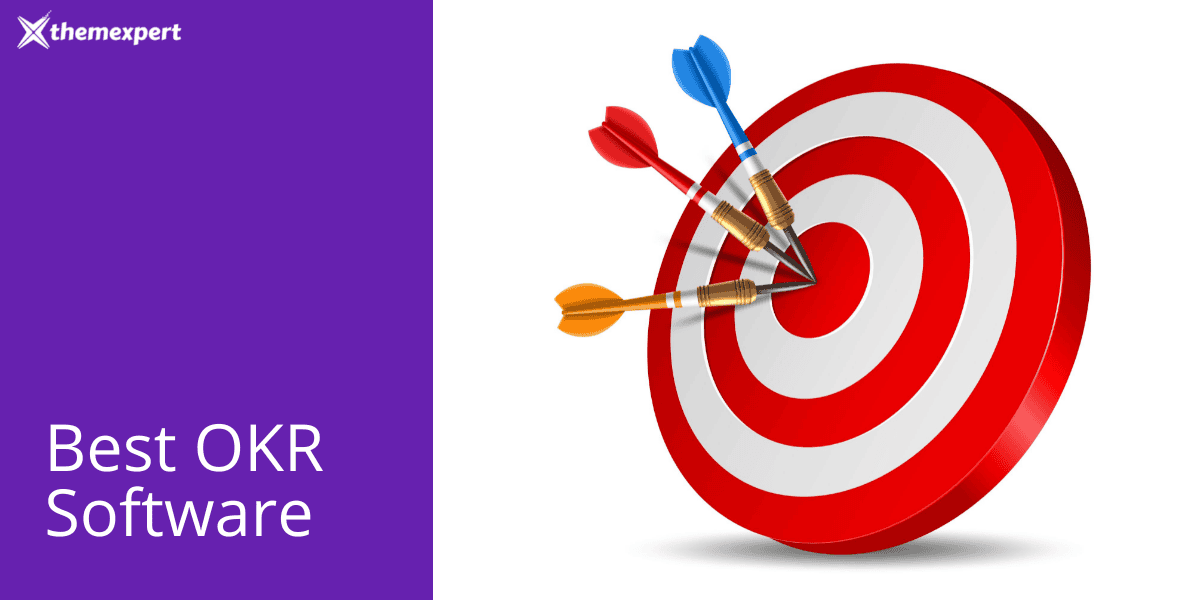
In this article, we’ll take an in-depth look at what OKRs software is, why it's indispensable for modern businesses, and the key factors to consider when selecting the right OKR software for your organization. We’ll also review the top 10 OKRs software available today, exploring their features, advantages, disadvantages, and pricing. By the end, you’ll be well-equipped to choose the best OKRs software and drive your business towards success.
😉
What Are OKRs?
OKRs, or Objectives and Key Results, are a strategic goal-setting framework used by organizations to align individual, team, and company-wide efforts with overarching business goals. This method serves as a powerful communication tool, ensuring that everyone in the organization understands and contributes to the company's mission and values.
OKRs consist of two main components:
Objectives: The objectives are the goals you want to achieve in your organization. They should be measurable and realistic. You can have more than one objective for each goal. For example, if you want to increase sales by 20%, then you might have two different objectives: Increase repeat sales by 5% and Increase new sales by 15%.
Key results: These are the specific actions or activities that will help you meet your objectives. It’s important to note that these must be measurable as well. If you don’t know how many widgets were sold last month, it’s hard to say whether you met your objective.
By combining ambitious goals with measurable benchmarks, OKRs help organizations maintain focus, drive alignment, and ensure accountability across all levels. They are especially valuable in fast-paced or scaling environments where clarity and execution are critical.
To dive deeper into the concept of OKRs, you can visit the full article on Wikipedia.
What is OKR software? What are the benefits of using OKR software?
OKR software is a type of performance management software that helps organizations set, track and measure their Objectives and Key Results (OKRs). OKR software helps organizations align their teams, departments and overall business goals, while providing visibility into progress and results. Benefits of using an OKR software include:
- Improved visibility: Objectives and Key Results (OKRs) software gives employees and their supervisors a better sense of progress and where they stand in terms of meeting their organizational objectives. This visibility into objectives and the ability to track progress over time ensures everyone is aligned and accountable.
- Improved alignment: By tracking objectives and measuring key results, OKRs help keep teams on the same page and make sure everyone is working together towards a common goal. This alignment helps employees understand why their work matters and how it fits into the larger organizational vision.
- Increased engagement: Setting objectives and tracking their progress helps employees feel more connected to their work and keeps them engaged with the organization. Employees are more likely to feel motivated and invested when their work has purpose and meaning.
- Improved performance: With OKRs, organizations can identify weaknesses, set targets, and gauge performance so that teams can make more informed decisions. This data-driven approach can positively impact performance and provide teams with actionable.
How to choose the right OKR software?
Selecting the right OKR (Objectives and Key Results) software is a strategic decision that can significantly impact your organization's ability to set, track, and achieve its goals. The ideal platform should not only facilitate performance measurement but also promote alignment, transparency, and cross-functional collaboration.
An effective OKR solution serves as a centralized system that ensures all departments and teams are moving in the same direction. It empowers leadership to identify bottlenecks, track progress in real time, and make data-informed decisions to optimize outcomes. Moreover, the right software keeps your organization focused, agile, and aligned with its strategic priorities.
Below are key criteria to consider when evaluating OKR software:
Organizational:
1. Define Your Organizational Needs
Start by identifying what you require from the software. Consider:
-
The size and structure of your organization (startup, mid-market, or enterprise)
-
Your budgetary constraints
-
Specific features you need (e.g., real-time tracking, integrations, reporting capabilities)
-
The level of customization required
-
Security and compliance standards
Clarity on these needs will guide your search and prevent wasted time on unsuitable platforms.
2. Conduct Thorough Research
Explore various OKR tools that align with your needs. Pay close attention to:
-
User reviews and testimonials
-
Feature comparisons
-
Pricing models and scalability
-
Industry reputation
Shortlist platforms that balance functionality, ease of use, and value.
3. Evaluate Usability Through Testing
Before committing, take advantage of free trials or product demos. This hands-on approach will help you assess:
-
Ease of use and user interface intuitiveness
-
Onboarding experience
-
Integration with existing systems (e.g., Slack, Microsoft Teams, HRIS tools)
-
Reporting and analytics capabilities
A good OKR system should enhance—not complicate—your workflow.
4. Assess Customer Support and Onboarding Services
Strong customer support is non-negotiable. Ensure the vendor provides:
-
Multiple support channels (chat, email, phone)
-
A responsive help desk with knowledgeable staff
-
Onboarding and training resources
-
A dedicated customer success manager (for larger deployments)
Reliable support minimizes downtime and helps you maximize the platform’s potential.
Functional:
-
Data visualization: It is extremely important that the software you choose is able to visualize OKRs in different formats such as tables, graphs etc.
-
Customizability: The software you pick must be highly customizable to satisfy all your company's needs.
-
Clarity of communication: The software you choose must facilitate smoother communication between teams and individual team members.
-
Analytics reporting: The whole point of an OKRs software is that it helps you track growth. Analytics play a huge role in this regard.
Top 10 of the best OKR software right now
We’ve already learned the objectives and Key results software and its uses. We’ve also discussed all the benefits an organization may reap if they were to use them. Now, it’s time to look at 10 of the best OKRs software currently on the market.
Betterworks
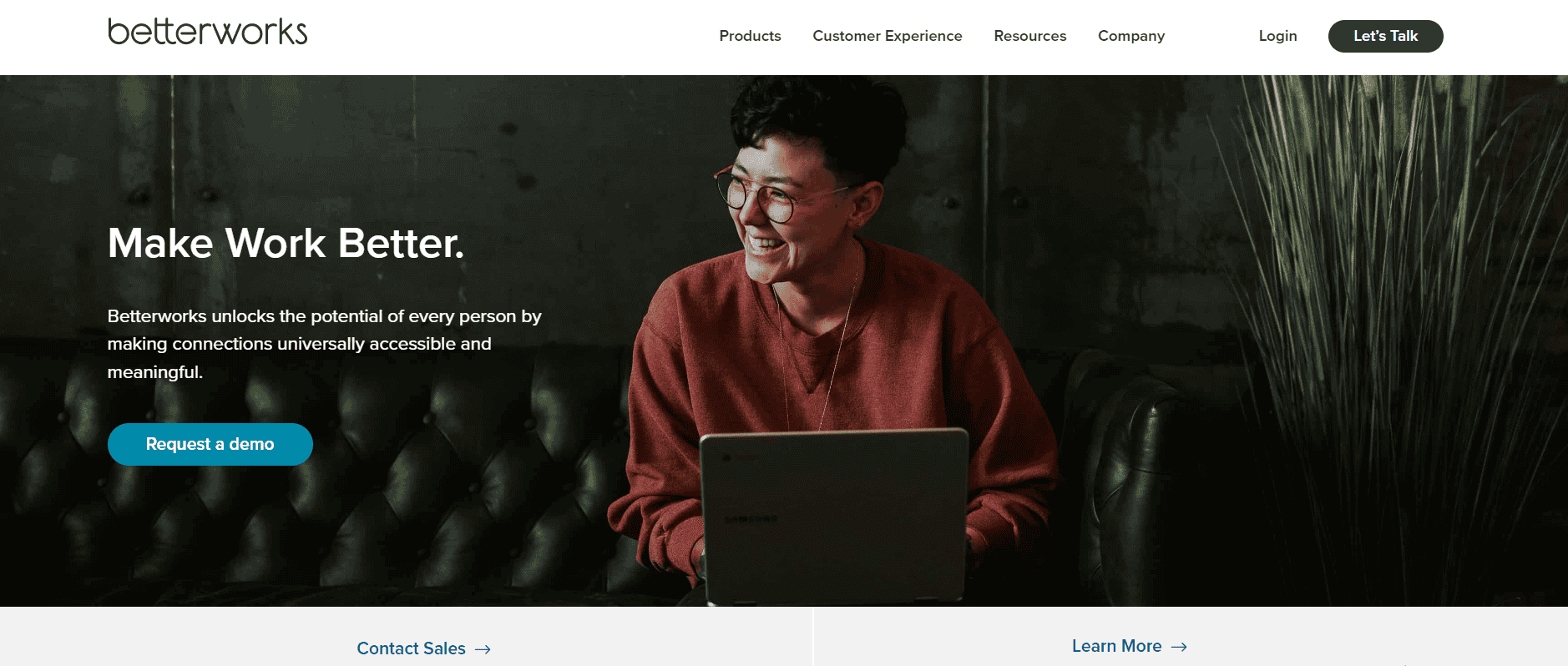
Betterworks is especially beneficial for a business with more than 250 employees that seek to utilize an OKR management system to assess employee progress and track corporate objectives. It is specifically helpful for managing OKRs, fostering transparency, and ensuring accountability.
Best for
- Betterworks is versatile enough to fill the needs to any business no matter their size
Features
- Configure emails to send work reminders and motivate your team to set OKRs
- Track progress by mapping out quarterly developments and setting milestones
- Send brief, regular surveys to gain insights on employee engagement
- Employees can view manager and peer feedback quickly to scale their performance
Pros |
Cons |
|
Insights feature |
Not user friendly |
|
Unlimited OKR coaching sessions |
Requires time to learn |
|
Offers a free trial |
Pricing
Betterworks team edition |
$8/user per month, billed annually |
|
$10/user per month, billed quarterly |
|
Engage team edition |
$2/user per month, billed annually |
|
$2.50/user per month, billed quarterly |
|
|
Enterprise |
Custom pricing |
Perdoo
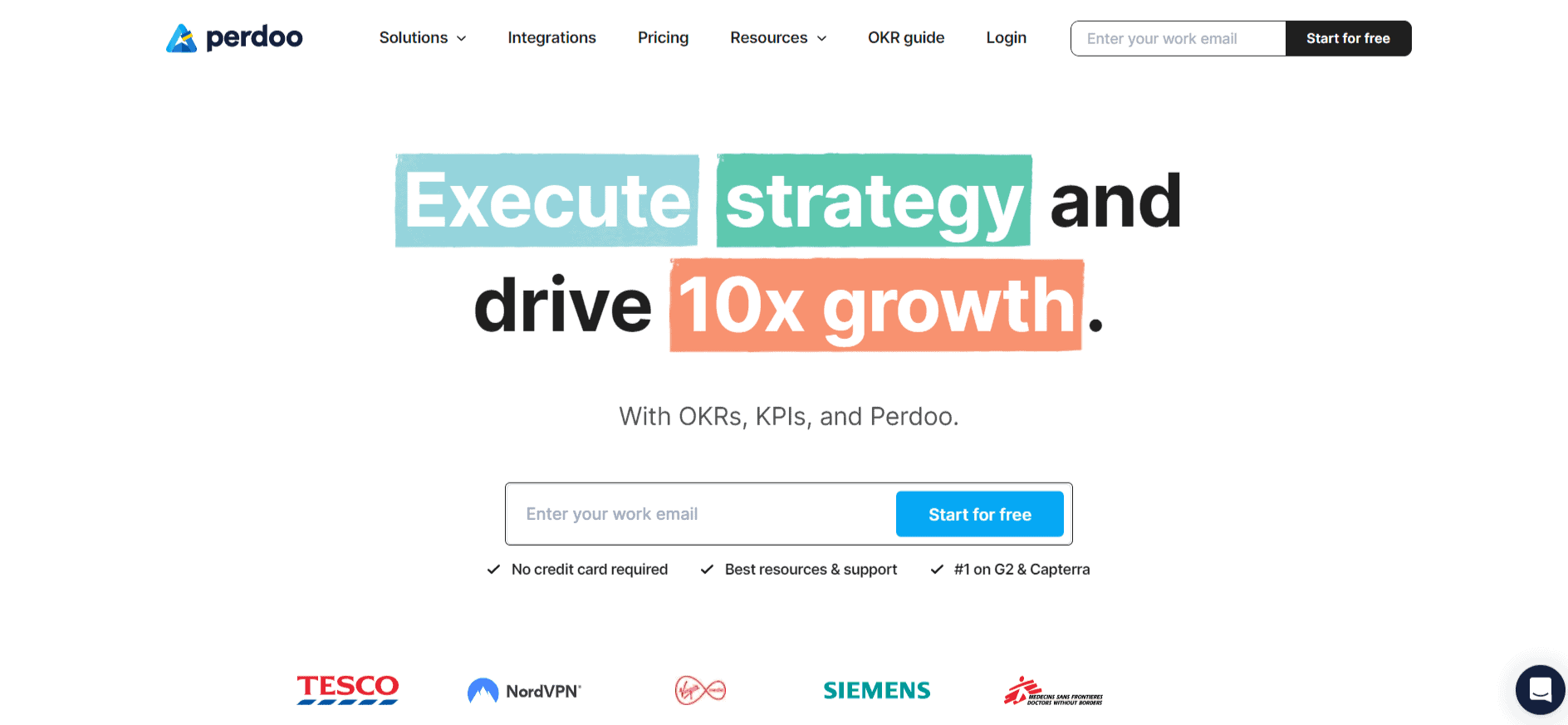
Perdoo, a German company, is an OKR tool with a simple and intuitive design. It features a roadmap for viewing company and team objectives over time, and offers integrations with popular workspace platforms like MS Teams, Slack, Jira, and Google Sheets. Additionally, it provides OKR coaching services.
Best for
- Plans are modified to fit all different-sized businesses
Features:
- Extensive integration capabilities (Microsoft teams, Jira etc)
- Road map builder to track progress
- Robust API that makes integrations easier
- Weekly progress report
Pros |
Cons |
|
OKR and KPI tracking under one software |
Mobile app not user friendly |
|
Extensive progress tracking features |
|
|
Slack integration |
Pricing
Software:
|
Free |
$0, (up to 10 users) |
|
Pro |
$6.50/user per month, billed annually(Min.10 users) |
|
$7.50/user per month, billed quarterly(Min.10 users) |
|
|
Premium |
$9.50/user per month, billed annually(Min.25 users) |
|
$10.90/user per month, billed quarterly(Min. 25 users) |
|
|
Supreme |
$17/user per month, billed annually(Min.25 users) |
|
$19.50/user per month, billed quarterly(Min.25 users) |
OKR Coaching:
|
Small |
$265/hour for 9 hours |
|
Medium |
$220/hour for 24 hours |
|
Large |
$180/hour for 48 hours |
|
One hour of coaching |
$300 |
15Five
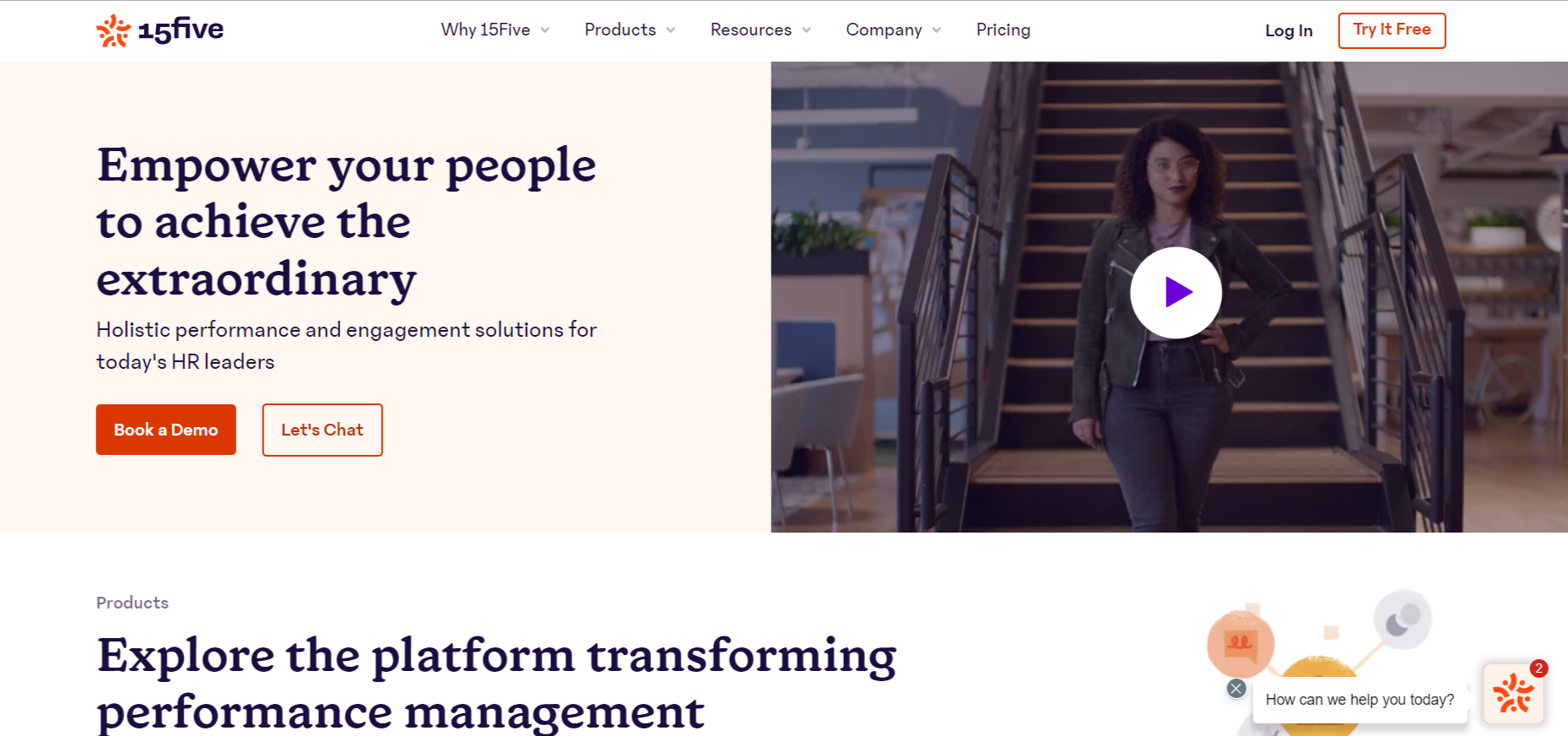
15five's OKR software improves performance and employee engagement, allowing you to take action on insights from evidence-based assessments. This tool helps you identify successes and issues, so you can take action to empower employees and managers for better outcomes. It provides a modern, multi-dimensional approach to performance reviews.
Best for
- Mainly recommended for smaller teams but can support bigger businesses as well
Features
- Robust performance evaluation for HR managers
- Highly detailed 360 approach-based performance review system
- Extensive OKRs breakdown starting from company level down to individual team level
- In-house OKR coaching
Pros |
Cons |
|
Easy to set up and use |
Limited customization options |
|
provides real-time insights |
Limited integrations |
|
offers a free trial |
Can be complex to use |
Pricing
|
Teams |
Engage |
$4/user per month, billed annually |
|
Perform |
$8/user per month, billed annually |
|
|
Individuals |
Focus |
$8/user per month, billed annually |
|
Enterprise |
Total platform |
$14/user per month, billed annually |
Workboard
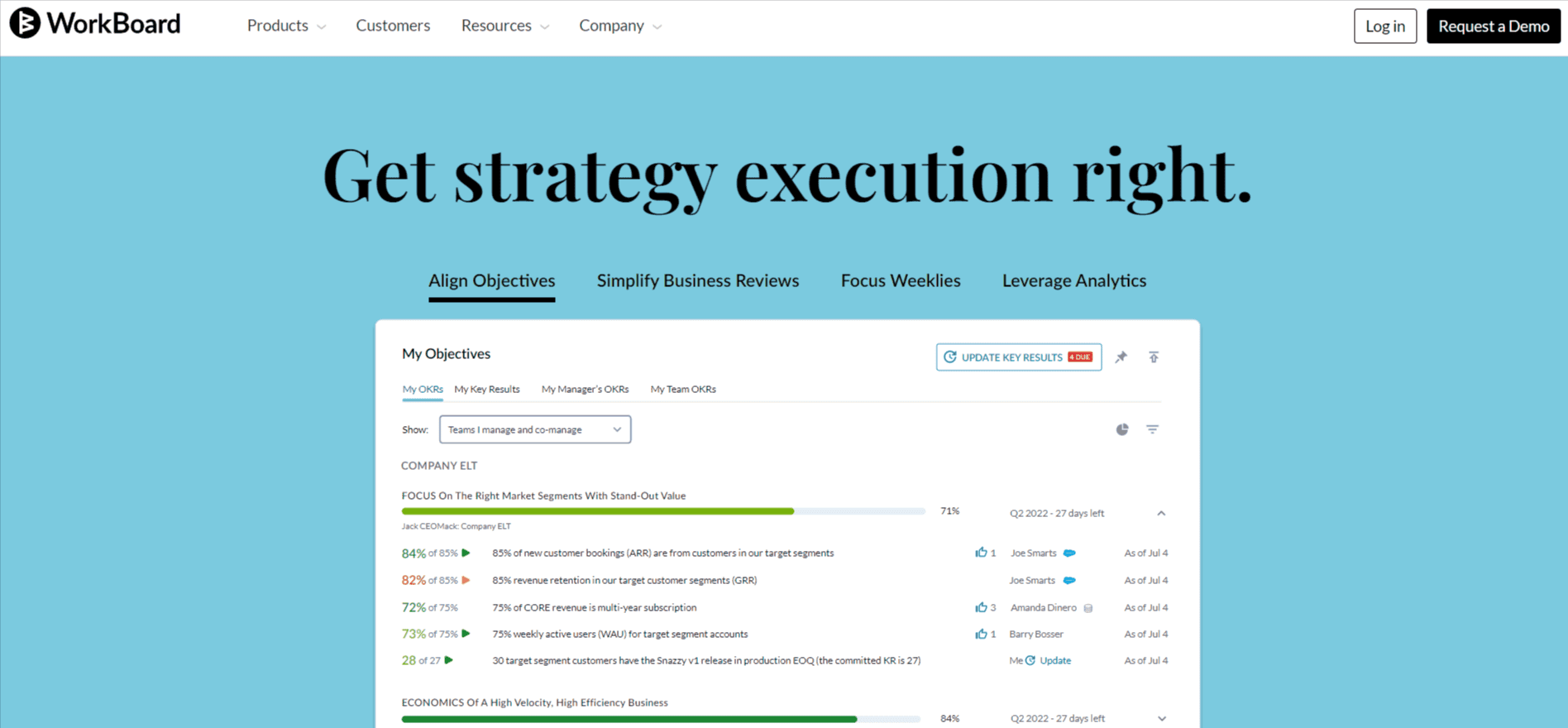
WorkBoard is a US-based Objectives and Key Results software platform used by large businesses to set objectives, measure goals and facilitate team communication. It is designed to provide motivation and clarity in regard to a company's objectives, with additional features such as integrations with Jira, Microsoft Teams, Azure DevOps, and Slack, as well as a meeting function to discuss OKR results. It has been running for nine years.
Best for
- It is an ideal platform for companies of all sizes, from startups to large enterprises
Features
- Effective team communication channels
- Meeting feature
- Quarterly reports based on key results
- Total data transparency for its OKR based features
Pros |
Cons |
|
Easy to set up and use |
Limited customization options |
|
Provides real-time insights |
UI may be confusing to some users |
|
Report generation and analytics |
Pricing
Workboard provides custom pricing depending on their client requirements.
Gtmhub
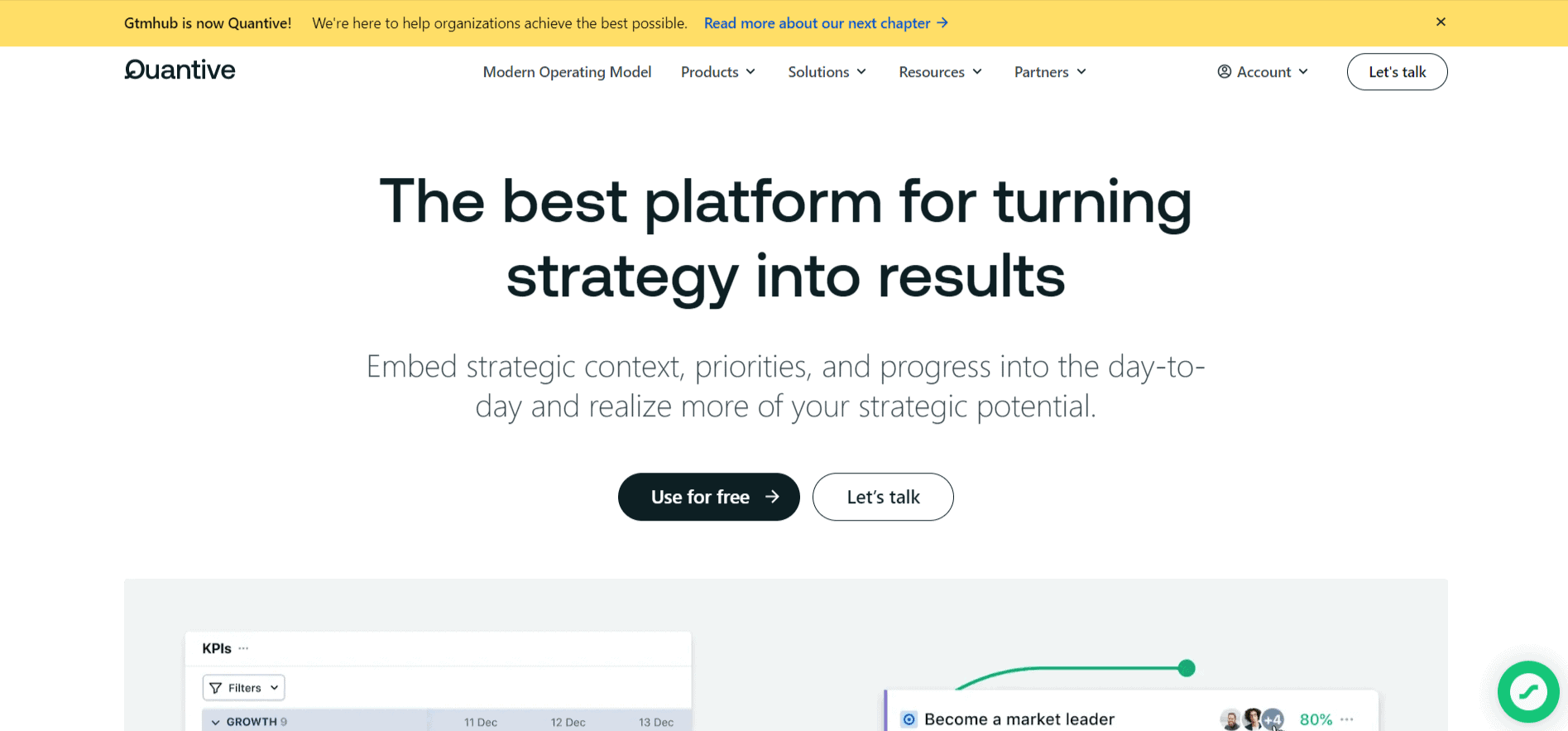
GTMhub is a goal management software designed to help teams and organizations reach their goals faster by tracking progress and providing meaningful insights. It combines goal setting, progress tracking, and performance management into one easy-to-use platform to help teams stay on track, stay motivated, and get better results.
Best for
- Can be used by SMBs and large enterprises as well
Features
- Simple OKR management
- Goal alignment allows everyone to keep track of how their efforts are contributing to the common mission
- Task management
- Custom OKR templates
- On-demand training
- OKR consulting
Pros |
Cons |
|
Goal alignment features to keep teams working in sync |
The pricing of the service can be expensive for some companies and organizations |
|
Easy to use |
|
|
Business data analytics |
Pricing
|
Essentials |
Free |
|
Scale |
$18/user per month |
|
Enterprise |
Custom pricing |
Peoplebox
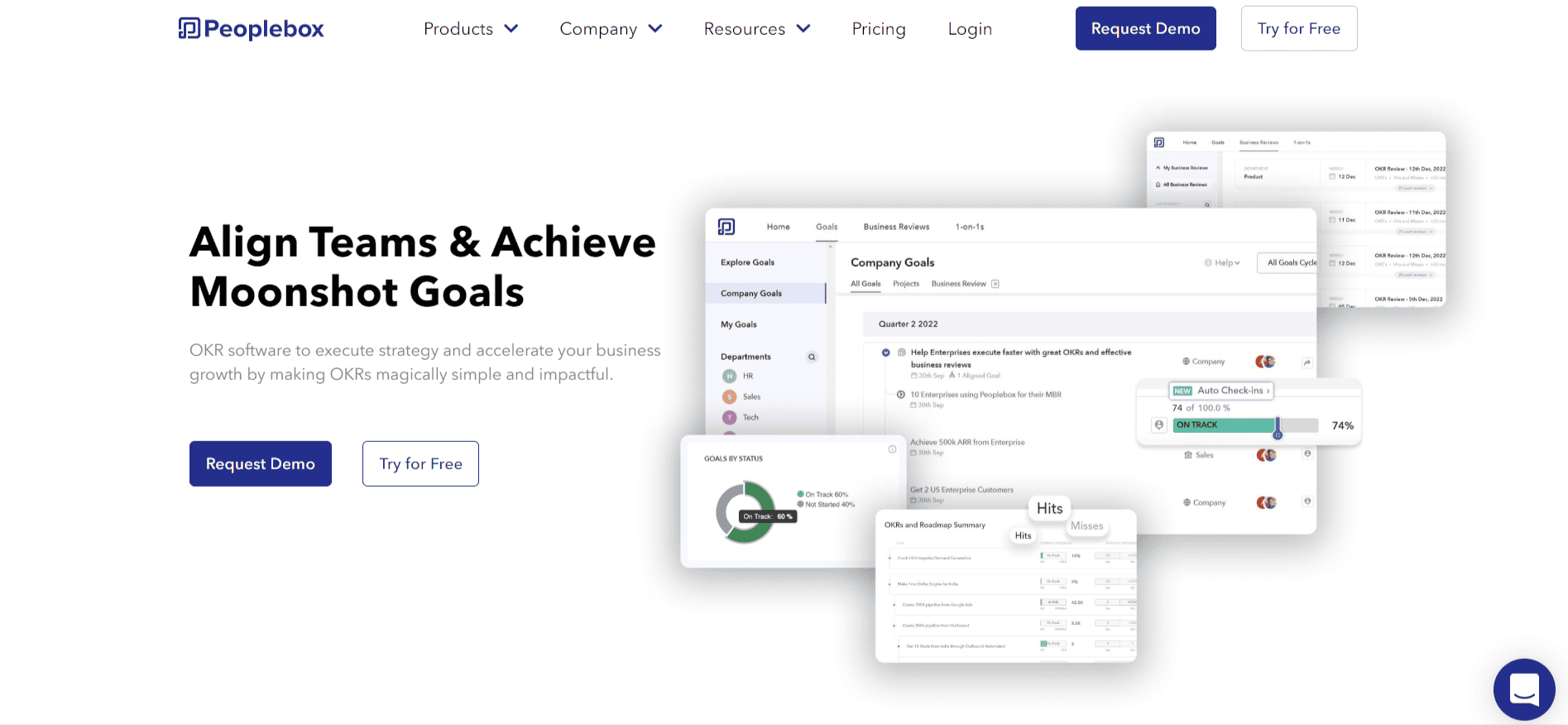
Peoplebox is a revolutionary employee engagement platform that helps companies build an engaged and productive workforce. It provides a suite of tools to create a culture of recognition, feedback, and collaboration.
It leverages the latest technology to make communication and collaboration easier and more efficient. Peoplebox helps companies create a workplace where employees feel valued and motivated to do their best work.
Best for
- Mainly intended for SMBs
Features
- Peoplebox’s automated recruitment feature simplifies the process of finding and tracking job candidates
- Performance Management Tools
- Time & Attendance Tracking
- Employee Self-Service Portal
- Task Management System
- HR Insights & Analytics
Pros |
Cons |
|
User-friendly interface |
Can be confusing to use for first time users |
|
Robust reporting features for tracking performance indicators |
No free version available |
|
mobile app for easy access from anywhere |
Pricing
|
Professional |
$8/month per person, billed monthly $7/month per person, billed annually |
|
Premium |
$16/month per person, billed monthly $15/month per person, billed annually |
|
Enterprise |
Custom pricing |
Mooncamp
Mooncamp is the perfect platform for purpose-driven and agile teams to stay on track and reach their goals. With Mooncamp, you can easily define your OKRs and objectives, check in on progress, and keep your team aligned and focused on a common goal.
The platform is designed to increase productivity, transparency, and results for your business. Mooncamp is the all-in-one solution for your team's success.
Best for
- Intended mainly for SMB use but can scale for enterprise-level businesses as well
Features
- OKRs can be managed from Microsoft teams
- Unlimited goals, initiative and hierarchy breakdown
- Multi alignment of OKRs which means one goal can be aligned with two or more parent goals
- Extensive integration available (Slack, Microsoft teams, GSuite SSO, Asana etc)
- Custom templates for check-ins and reminders
- Check-ins and reminders in Slack and Microsoft teams as well
Pros |
Cons |
|
Easy to use |
No free package available |
|
Provides extensive integration |
The cheapest package has limited features |
|
OKRs, tasks and goals are highly customizable |
Pricing
|
Essential |
$6/month per user, billed annually |
|
Professional |
$10/month per user, billed annually |
|
Enterprise |
Custom pricing |
Reflektive
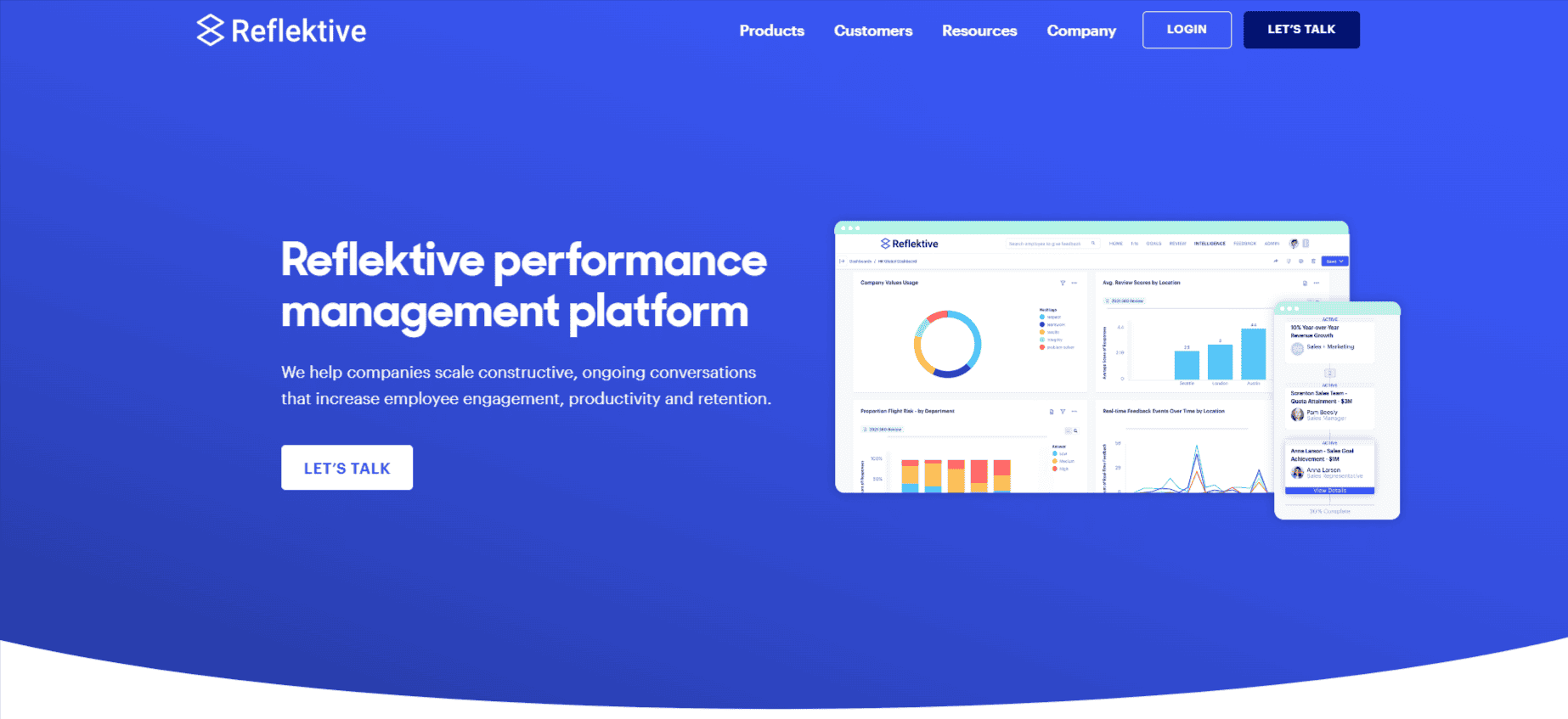
Performyard is a performance management software that streamlines the feedback, review, and goal management process. The 360-degree review module of the software allows customers and other members of the extended organization to provide their input at no extra cost.
Every pricing plan comes with a dedicated customer support manager for assistance. The software also enables employees to track and monitor their individual goals and store private notes of performance that can be accessed at any time.
Best for
- It’s mainly intended for SMBs. It has an enterprise level pricing package but that can be customized to an SMB with slightly greater requirements as well.
Features
- Having peers review each other's work
- Allowing for outside opinions
- Encouraging collaboration during the review process
- Being able to track progress visually
- Allowing for the use of custom tags
- Utilizing stacked bar charts
- Keeping an activity log
Pros |
Cons |
|
A dedicated support manager is included in the cost |
The goal management system could use some improvement |
|
The user and admin interface is user-friendly |
Integration with Google and other calendars is not yet available |
|
The customer service team is both professional and prompt |
The reporting features could be enhanced |
Pricing
|
Professional |
$5-10/user per month, billed annually |
|
Enterprise |
Custom pricing |
Lattice
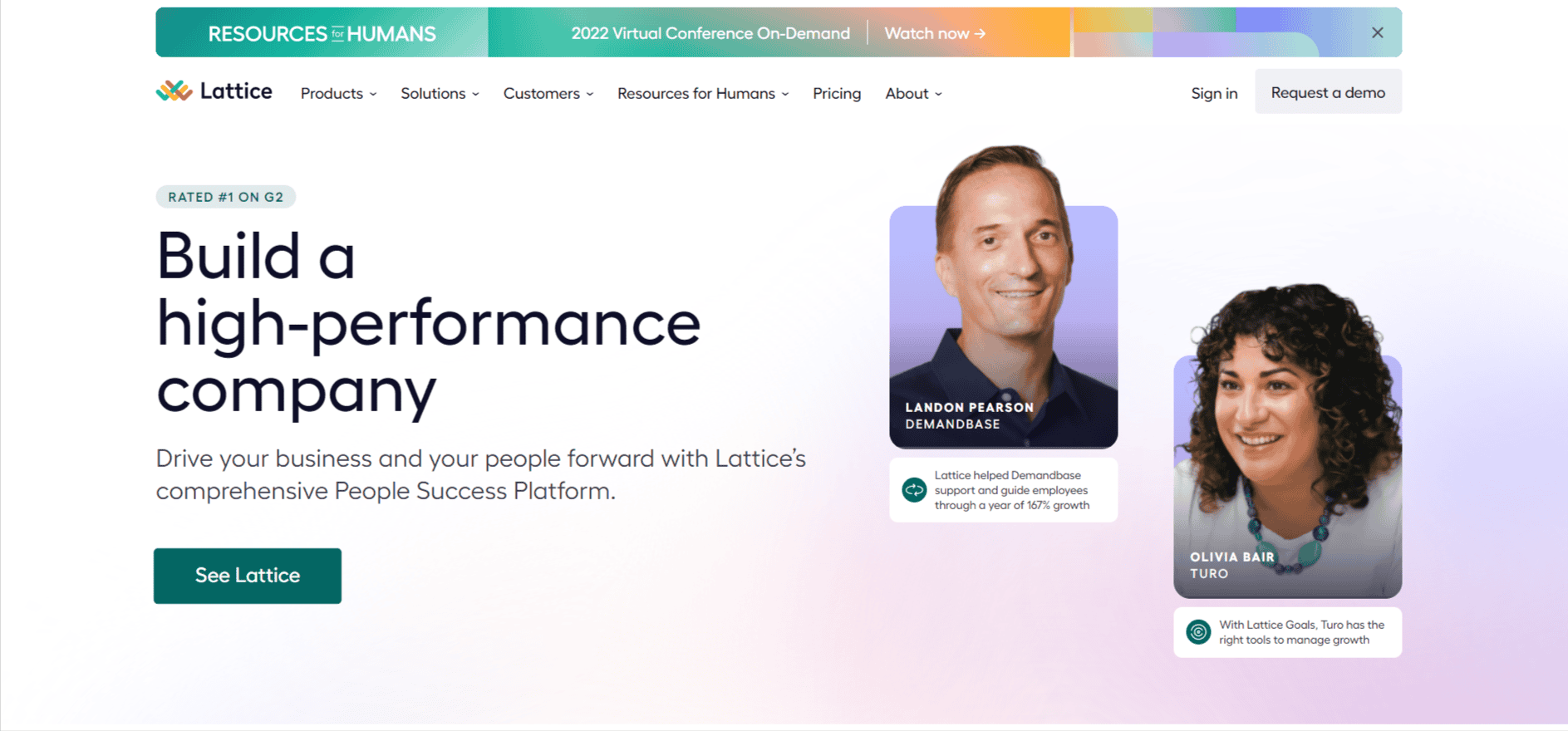
Lattice is a widely respected work management system, with its main base in San Francisco, and branches in New York and London. This platform provides you with tools for increasing employee involvement, evaluating performance, assigning and monitoring tasks, setting objectives and key results, and much more.
Best for
- Intended for SMBs
Features
- Analytical and reporting tools to measure performance
- The ability to set goals, assign importance, and monitor progress
- Visualization tools for goals and objectives
- Compatibility with Slack, Google Apps, Microsoft Teams, Outlook, and HRIS
- A mobile app
- Advisory service
Pros |
Cons |
|
Easy to use |
Goals can be confusing sometimes |
|
Helps you track against clear goals in one place |
Lack of templates for growth paths and reviews |
|
Weekly updates |
Pricing
|
Performance management + OKR and goals |
$11/user per month |
|
Engagement |
$4/user per month |
|
Growth |
$4/user per month |
|
Compensation |
$6/user per month |
Weekdone
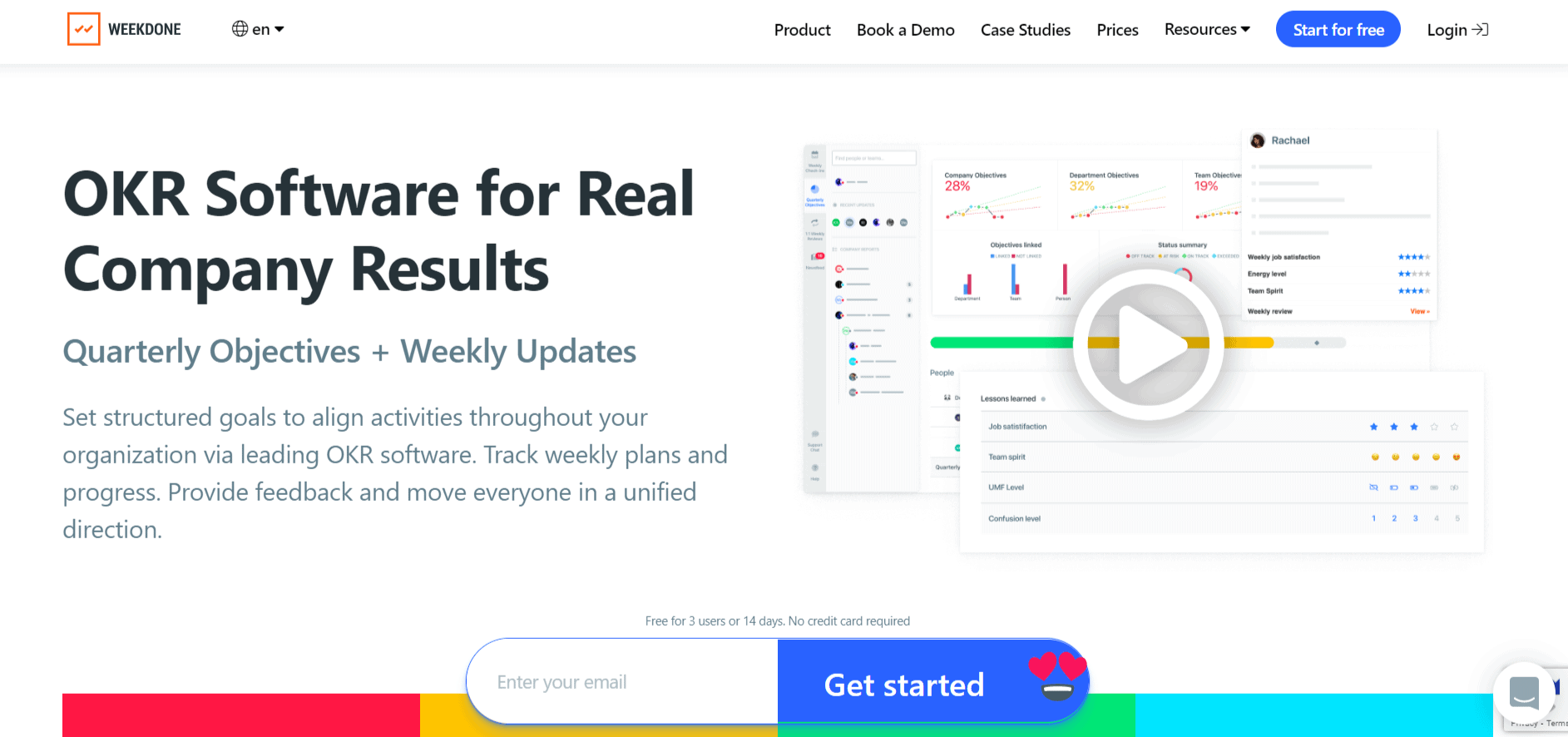
Weekdone is a tool for setting objectives and key results (OKRs), monitoring progress, organizing plans, and establishing a regular reporting system. It offers teams the structure they need to create and manage OKRs.
Best for
- Starting from small startups to large enterprise-level businesses, all can use Weekdone
Features
- Connect your weekly objectives to your OKRs to ensure that your weekly activities are contributing to your quarterly success
- Utilize the hierarchy view to observe the connection between your OKRs and the company's overall goals
- Take advantage of the different views available, such as the bird's-eye overview and the single OKR view, to best suit your needs
Pros |
Cons |
|
Integrations with Asana, Jira, Google Tasks and Slack |
Does not have project management capabilities such as comprehensive plans and Gantt diagrams |
|
The ability to customize measurement units (type/value) for Key Results |
|
|
A template for weekly reports that can be tailored to suit your business's values |
Pricing
|
Free |
$0 |
|
Custom |
Custom pricing |
Conclusion
OKR software can enable individuals to set goals and priorities and connect them with their organizational work. This can help them identify any gaps and how to improve upon them to achieve better outcomes.
There are a variety of OKR software solutions available, each with its features and varying price points. Therefore, choosing the best fit for the individual's requirements and budget is essential.