

The harshest reality no one shares when you start your first online store is that your biggest problem won't be competition but overspending on unnecessary tools and trying to match enterprise budgets that you don't have.
You probably keep hearing the sales pitch - "just use Platform X; it has everything." But when the bill comes in, you realize that the transaction fees pile up on top of subscription fees and app fees.
You are already in the red even before your first sale is made.
The year 2026 will be a different story. A fresh batch of cheap eCommerce platforms and supporting apps have been rolled out. They offer big business features to entry-level-priced startups.
It's never been easier to level the playing field.
This handbook is meant to simplify the decision-making process. We have done thorough platform ranking analysis, price check, and feature comparison for each product.
Why eCommerce Is Non-Negotiable for Small Businesses in 2026
The statistics tell the story. eCommerce sales worldwide are expected to hit $6.88 trillion in 2026, or 21.1% of total retail, meaning it is no longer a niche channel, but retail.
Shopping online continues to attract people as by 2026 there will be over three billion folks ordering products over the Internet.
Total worldwide eCommerce revenues have gone over $6.42 trillion. A large portion of them, 59%, or about $4.01 trillion, purchase goods via their mobile devices.
And what about small businesses? They've become even more active in this wave. According to US Census Bureau data, 52% of small US businesses with less than 10 employees now operate online.
Furthermore, 43% of small retailers reported eCommerce as their main revenue source in Q4 2023, an increase from 28% in 2021.
(Source: Gitnux Small Business eCommerce Statistics Report — fact-check recommended)
The issue is not whether you will have an online store, but which platform you can use without greatly reducing your margins.
What Makes an eCommerce Solution Truly "Affordable"?
Even though price is the most straightforward factor, it is not the right one to start with.
Inexpensive is a $29/month platform that will make you purchase five different apps separately to manage email, analytics, and abandoned carts — not really affordable but just a budget illusion.
Real affordability is characterized by:
- Transparent pricing — what you see is what you pay
- Native features — no mandatory paid add-ons for core functionality
- Zero or low transaction fees — keeping your margins intact
- Scalability — room to grow without platform-switching later
- Time cost — how fast can a non-developer get a store live?
🔑Key Insight: Many platforms look affordable at first but add hidden costs through transaction fees or the need for additional apps. Some offer free plans but lack built-in growth tools.
Considering the above pick criteria, here are the platforms that really deserve your attention in 2026.
Top Affordable eCommerce Solutions for Small Businesses in 2026
Quick Look at Platforms
|
Platform |
Starting Price |
Transaction Fees |
Best For |
Free Plan? |
|
Shopify |
$25/mo (Starter) |
0% (with Shopify Payments) |
All-in-one beginners |
No |
|
WooCommerce |
Free core plugin |
None (processor only) |
WordPress users |
Yes (core) |
|
StoreEngine |
$5.75/mo |
None |
All-in-One eCommerce Solutions |
Free version |
|
Hostinger |
$2.99/mo |
0% |
Ultra-budget beginners |
No |
|
Wix eCommerce |
$159/mo |
0% (Wix Payments) |
Brand-focused small stores |
No |
|
Ecwid |
$5 (10 products) |
None |
Add-a-store to any site |
Yes |
1. Shopify — The dependable all-purpose option

The reasons for Shopify's continued popularity are numerous. Prices for Shopify memberships are $25 to $299 a month, and there are no transaction fees with Shopify Payments on any plan.
The platform can support eCommerce businesses of any size, from lone entrepreneurs to global corporations, with over 16,000 apps available and round-the-clock customer service.
Who it's for: New sellers who want a well-tested, fully hosted solution that comes with everything they need in one package.
Watch out for: The abundance of apps may be overwhelming and not always cost-effective as many times the "free" features require paid apps for serious usage.
2. WooCommerce — Maximum Flexibility, Maximum Responsibility
WooCommerce is not only flexible but it has become a major player in the world of online eCommerce platforms. It provides thousands of plugins, themes, and options to sell across multiple channels.
WooCommerce powers 20.1% of global eCommerce sites.
However, it is important to highlight that while WooCommerce itself is free, hosting costs will add up to around $120 per year.
If you want a premium theme and other extensions, and you factor in your "free" store will become expensive in no time.
Who it's for: Those familiar with WordPress who are ready to take on a bit of the technical setup.
3. 🏆 StoreEngine — The Smart WordPress Alternative for 2026
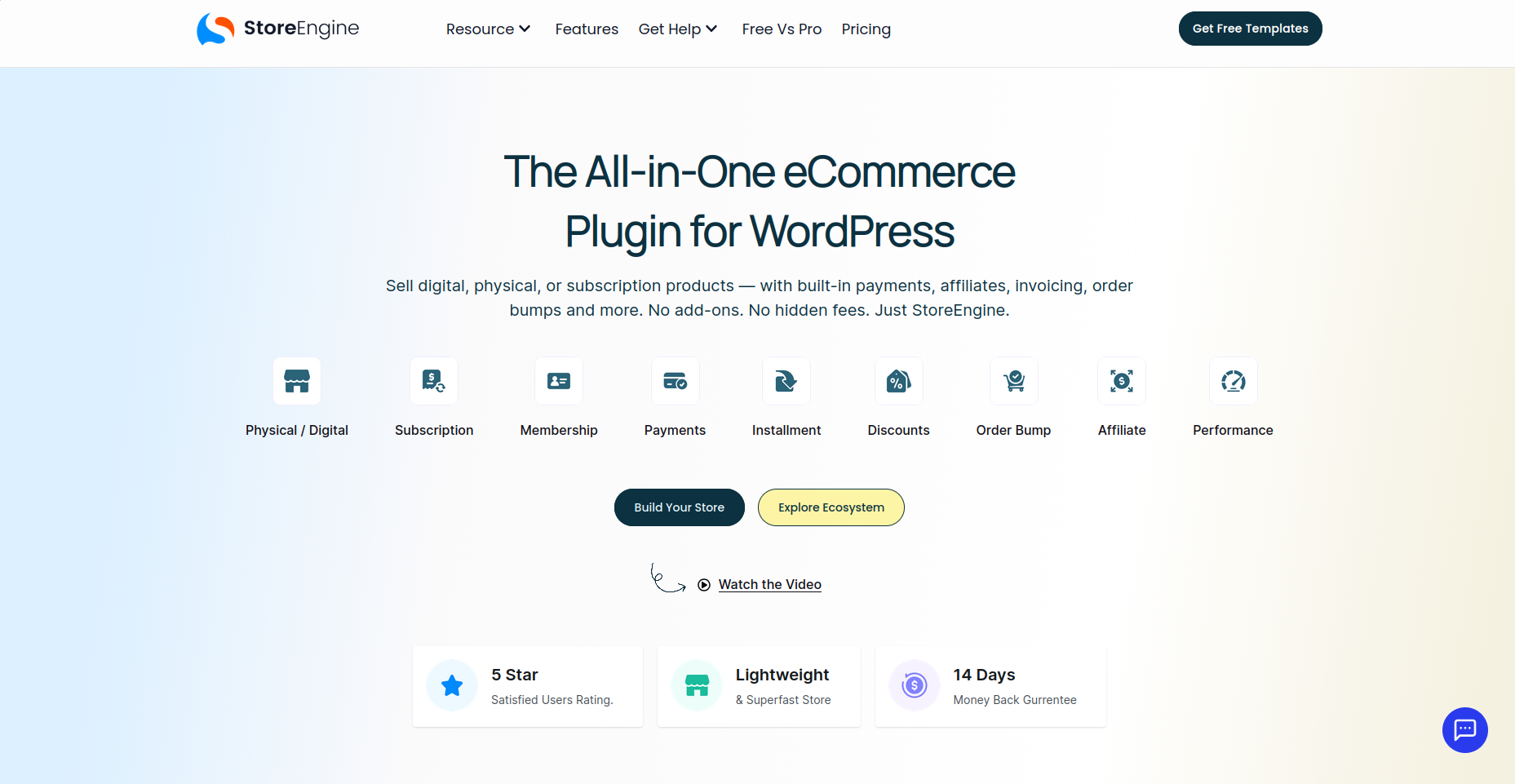
If you are a WordPress user and frustrated with patching together a set of 10 plugins merely to operate a simple store,
Then StoreEngine is worth careful consideration.It brands itself as an all-in-one eCommerce plugin for WordPress, and the team has actually delivered.
While WooCommerce requires separate, often costly extensions for affiliate management, subscription billing, membership access, digital downloads, StoreEngine comes with all those features out of the box.
What you get out of the box:
- Selling physical and digital products, memberships, subscriptions, and online courses — all in one plugin
- Affiliate management — no third-party tool needed for tracking referrals and commissions
- Recovering lost sales through automated emails to trigger abandoned carts
- Invoicing & Global Tax Management — automatically calculated, region-specific
- Order bumps & upsell funnels — conversion enhancers built in rather than patched on
- Payment gateways: The most popular ones like Stripe, PayPal, Razorpay, and Paddle are supported, including cash on delivery
- Handling product variations & real-time inventory control
- Seller dashboard with up to date analytics
- GDPR-compliant, 14-day money-back guarantee, 24/7 support
In plain terms, a user verified it like this: "StoreEngine is the best plugin I ever use... very lightweight, easy to use and you do not need extra plugins because, e.g., affiliate functionality is already included, membership and subscription are also included."
If your head is spinning thinking about all those WooCommerce extensions.
Switch to StoreEngine!
4. Hostinger — The Ultra-Budget Starter
On the other hand, if you're going for the absolute bare bones launch, Hostinger Business plan gives you the possibility to run your eCommerce store for a very low price of $2.99 per month.
Hostinger is currently recognized as the most affordable eCommerce website builder not only suitable for beginners but also for side hustles.
It offers a very easy setup which even budget conscious side hustlers can use to build their store quickly.
Limitations: Only one eCommerce plan with a 1,000-product limit. Growing brands will outgrow it fast.
5. Wix eCommerce — The Visual Builder
Creating an online shop with Wix is effortless as there is a drag-and-drop builder, over 2,000 templates to choose from, and AI tools.
Wix also features safe payment options, SEO tools, and marketing capabilities. Highly suited for brand-centered small stores. Not the best choice for complicated product catalogs.
6. Ecwid — Add a Store to Any Website
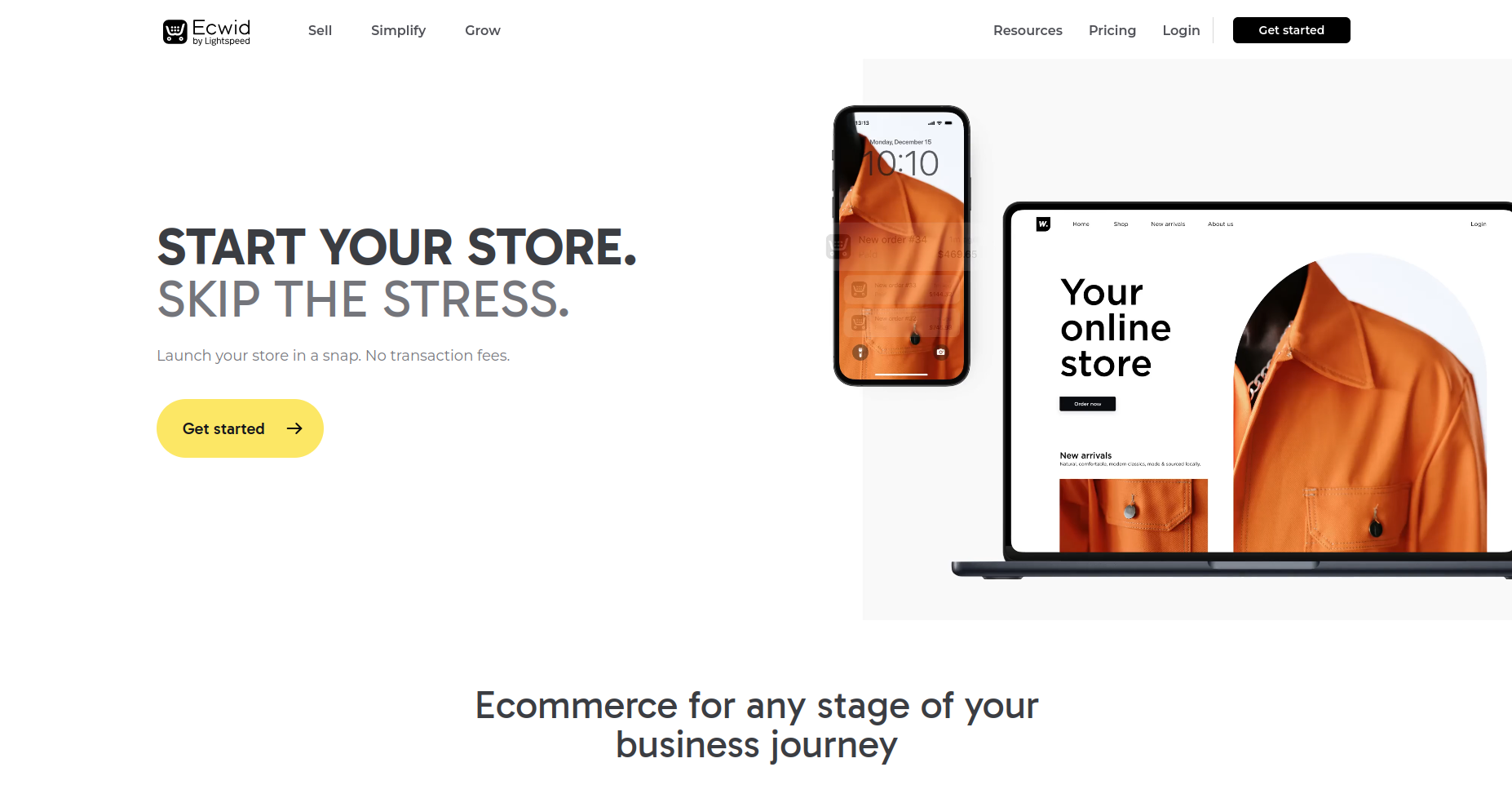
Ecwid offers a minimalist eCommerce solution that is easy to use, supports selling through multiple channels, and offers a free plan that never expires for beginners.
Drawback: The free plan is limited to 10 products, good for trial but restricted for serious selling.
Essential eCommerce Tools Every Small Business Needs in 2026
Besides the platform, having the right set of tools can help a lot in lifting your store from a crawling pace to a conveyor one.
|
Tool Category |
What It Does |
Budget Option |
|
Email Marketing |
Abandoned cart recovery, promotions |
Mailchimp (free tier), Klaviyo |
|
Analytics |
Track traffic & conversions |
Google Analytics 4 (free) |
|
SEO |
Rank in search results |
Yoast / Rank Math (WordPress) |
|
Payment Gateway |
Process transactions |
Stripe, PayPal |
|
Shipping |
Automate labels & rates |
ShipStation, EasyShip |
|
Reviews & Social Proof |
Build trust |
Judge.me, Yotpo |
|
Live Chat |
Convert visitors in real time |
Tidio (free tier) |
Key Features to Look for in Budget eCommerce Platforms
Don't make any commitment without looking at this checklist:
✅ Must-Have Features
- Mobile-optimized storefront (don't forget: mobile commerce accounted for 59% of all online retail sales in 2025)
- SSL certificate & PCI-compliant payments
- SEO-friendly product pages
- Inventory management & order tracking
- Abandoned cart recovery
✅ Growth-Enabling Features
- Multichannel selling (social media, marketplaces)
- Built-in email marketing or integrations
- Analytics dashboard
- Affiliate or referral programs
- Discount & coupon management
🚩 Red Flags to Watch
- Transaction fees on top of monthly fees
- Core features locked behind expensive tiers
- No scalable upgrade path
- Lack of 24/7 support
How to Choose the Right eCommerce Platform for Your Small Business
Do a full compatibility check before going for a platform. The choice of your platform is like picking a business partner.
You want to get along with budget, ambition, and technical skills rather than just a short-term convenience.
Step 1: Define your product type. Physical goods, digital downloads, services, subscriptions — not every platform handles all of these natively.
Step 2: Set your total budget. Include hosting, domain, apps, and payment processing — not just the monthly subscription.
Step 3: Assess your technical comfort. Hosted SaaS platforms (Shopify, Hostinger, Wix) require zero technical skills. WordPress plugins (WooCommerce, StoreEngine) need a WordPress install but offer far more control.
Step 4: Think about year two. Switching platforms later is costly and disruptive. Choose a solution you won't outgrow.
Step 5: Use free trials. Add products, test checkout, and feel the interface before you commit.
2026 eCommerce Trends Small Businesses Should Know
AI is everywhere. 84% of eCommerce businesses now rank AI as their top technology priority. From product recommendations to abandoned cart detection, AI-powered features are filtering into even budget-friendly platforms.
Social commerce is a real channel now. US social commerce sales are on track to surpass $ 102.8 billion in 2026. Your store should connect to where your customers already scroll.
Cart abandonment is the biggest revenue leak. Cart abandonment averages 70.19%, costing US retailers an estimated $705 billion annually. Built-in recovery tools aren't a nice-to-have — they're essential.
The eCommerce platform market itself is booming. The global eCommerce platform market is projected to grow from $13.92 billion in 2026 to $61.83 billion by 2034, at a CAGR of 20.49%.
Conclusion
The eCommerce opportunity in 2026 not only is real and immense but also is more accessible than ever before.
However, it is your decisions regarding the choice of tools that will either lead to the rapid increase of your business or, on the contrary, gradually eat away your profits.
Sometimes, it might not even be the cheapest solution that will end up being your best affordable eCommerce platform.
It is most likely the one that does the biggest share of work for you without constantly needing to buy extras to reach the essential set of features.
If you are a WordPress user and want to stop piecing together plugins and start selling seriously, StoreEngine is a strong candidate.
Hostinger or Ecwid will, however, work well if you are new and extremely budget conscious. If, on the other hand, you want a safe all-rounder with the widest possible range of features offered by the ecosystem, then Shopify with its starter plans is still very hard to beat.
Your perfect platform is the one with which you will still be happy two years down the road. Keep the long-term perspective in mind and don't allow hidden fees to be the thing that stops your progress.
Frequently Asked Questions
What is the most affordable eCommerce platform for small businesses in 2026? Hostinger ($2.99/mo) is the most budget-friendly among hosted solutions and has 0% transaction fees. For WordPress users, StoreEngine is an all-in-one plugin that saves you a lot of money when you consider the total cost of tools in addition to being very cost-effective.
Can I run a free online store? Yes — platforms like Ecwid and Square Online offer free plans. However, free plans typically cap you at 10 products or include transaction fees. They're great for testing but limited for scaling.
What's the difference between a hosted eCommerce platform and a WordPress plugin? A hosted platform (Shopify, Wix, Hostinger) manages everything — hosting, security, updates — for you.
A WordPress plugin (WooCommerce, StoreEngine) runs on your existing WordPress site, giving you more control and customization at the cost of slightly more setup responsibility.
Do I need coding skills to build an online store? No. Every platform on this list offers visual builders or guided setup flows. Tools like StoreEngine use drag-and-drop customization via visual editors — no code required.
Is WooCommerce free? The core WooCommerce plugin is free, but you'll need to pay for WordPress hosting (roughly $5–$30/month), a premium theme, and likely additional extensions, which can add up quickly.
Alternatives like StoreEngine bundle more features natively, reducing overall plugin costs.
What should I prioritize when choosing a budget eCommerce platform? Start with: zero or low transaction fees, mobile optimization, built-in SEO tools, and whether the platform includes features like cart recovery and analytics natively — rather than requiring paid add-ons.
Is StoreEngine a good alternative to WooCommerce? For WordPress users who want to avoid the "plugin stack" headache, yes.
StoreEngine bundles affiliate management, subscription billing, membership control, digital downloads, invoicing, and cart abandonment recovery into a single lightweight plugin — features that typically require multiple separate tools inWooCommerce.