
You’ve got one online store, it’s doing fine. But you keep thinking about the bigger version — the one where other sellers list their own products, you collect a commission on every sale, and the store grows itself instead of you carrying it alone.
That’s the multi-vendor dream. The problem is getting there usually means picking a plugin, discovering it needs three more paid add-ons just to pay vendors properly, and watching your “simple marketplace” turn into a stack of six plugins fighting each other.
It doesn’t have to go that way. A handful of WordPress multi-vendor plugins in 2026 are genuinely built to get you from a single-seller store to a full marketplace without the usual plugin pile-up.
This guide breaks down the best ones — what each is actually good at, what it costs, and which one fits the marketplace you’re trying to build.
Why Your Multi-Vendor Plugin Choice Actually Matters
A multi-vendor eCommerce plugin turns your WordPress store into a real marketplace — vendor registration, individual seller dashboards, commission splitting, payouts, and order management all running under one roof.
Get this choice wrong and you’ll be migrating vendor data, commission structures, and payout history later, which is far more painful than switching a single-seller store.
Building a multi-vendor marketplace on WordPress is no longer limited to one dominant plugin — store owners today can choose from several mature solutions that extend their store and let independent sellers list products, manage orders, handle shipping, and receive commissions on their own.
The right pick depends on your business model, your technical resources, and how much vendor control you actually need.
Best Multi-Vendor eCommerce Plugins for WordPress in 2026 — At a Glance
| Plugin | Best For | Free Version | Starting Price (Paid) |
|---|---|---|---|
| StoreEngine | All-in-one store with multi-vendor built in | Yes — fully featured | Premium plans from $99/year |
| Dokan | Fastest visual setup, polished vendor dashboard | Yes | Premium plans from $149/year |
| WC Vendors | Flexible commissions, native Stripe Connect payouts | Yes | From $99.50/year |
| WCFM Marketplace | Free-tier marketplaces, high install base | Yes — strong free tier | Paid add-ons available |
| MultiVendorX | Rental and booking marketplaces | Yes | From $299/year |
Callout: Notice the split here — StoreEngine and Dokan are built to be the whole marketplace engine on their own, while WC Vendors, WCFM, and MultiVendorX lean more on paid add-ons as your marketplace grows. Know which model you’re buying into before you commit.
1. StoreEngine — The All-in-One Pick
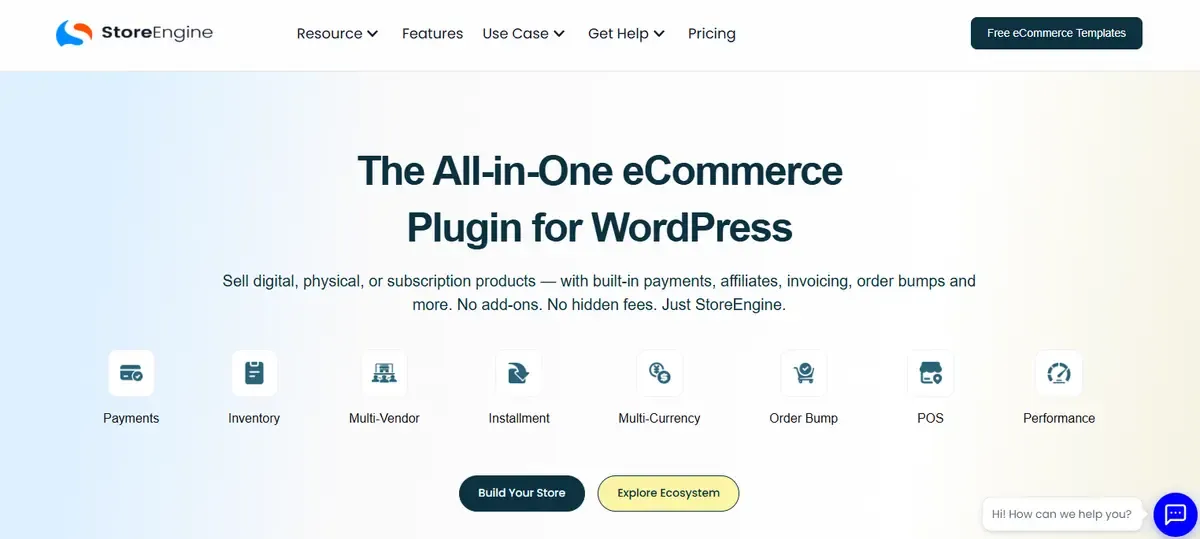
Most multi-vendor plugins hand you a bare vendor registration form and then bill you for everything else — payouts, commission rules, dashboards, all separate add-ons. StoreEngine takes a different approach.
It’s built as a complete eCommerce engine first, with multi-vendor functionality, subscriptions, affiliates, and an advanced analytics dashboard included rather than bolted on.
The whole point is skipping the plugin mess: manage inventory, variants, shipping, and vendor operations without needing to add three more tools to make it work.
Where most competitors treat vendor tools as premium extras, StoreEngine packs upsells, cross-sells, a built-in affiliate system, and multi-tier pricing (one-time or subscription, with free trials and setup fees) directly into the core plugin.
Key Features
- Native multi-vendor marketplace support alongside standard single-store selling
- Built-in affiliate system to track referrals and manage vendor or partner payouts
- Advanced analytics dashboard covering revenue trends, product performance, and conversions in one view
- Multi-currency and installment payment support for global marketplaces
- Point-of-sale (POS) support for vendors who also sell in person
- Upsell and cross-sell tools to increase average order value across the marketplace
Pricing: StoreEngine offers a free version with core features like product management and basic payments through PayPal and Stripe. Premium plans start around $99/year for Pro and Enterprise tiers, which unlock subscriptions, memberships, affiliates, digital licensing, and priority support.
Best for: store owners who want a single plugin to run both their core store and a multi-vendor marketplace, without stacking separate tools for payouts, affiliates, and analytics.
2. Dokan — Fastest Visual Setup

Dokan is one of the most established multi-vendor plugins for WordPress, built to help you launch a marketplace similar to Amazon, Etsy, or eBay in under 30 minutes.
It’s known specifically for its polished frontend vendor dashboard and the fastest visual setup experience among the major marketplace plugins, with more than 60,000 active installs.
Key Features
- Guided setup wizard that gets a functioning marketplace live quickly
- Polished, easy-to-navigate frontend dashboard for vendors
- Rich admin controls for commission rules, vendor approval, and store management
- Works smoothly with WordPress 4.4 and above, with regular updates
Pricing: A free version is available on WordPress.org with core marketplace functionality. Paid tiers starting for $149 yearly.
Best for: marketplace builders who want the quickest path from install to a working vendor storefront, with minimal setup friction.
3. WC Vendors — Best for Flexible Commission Structures
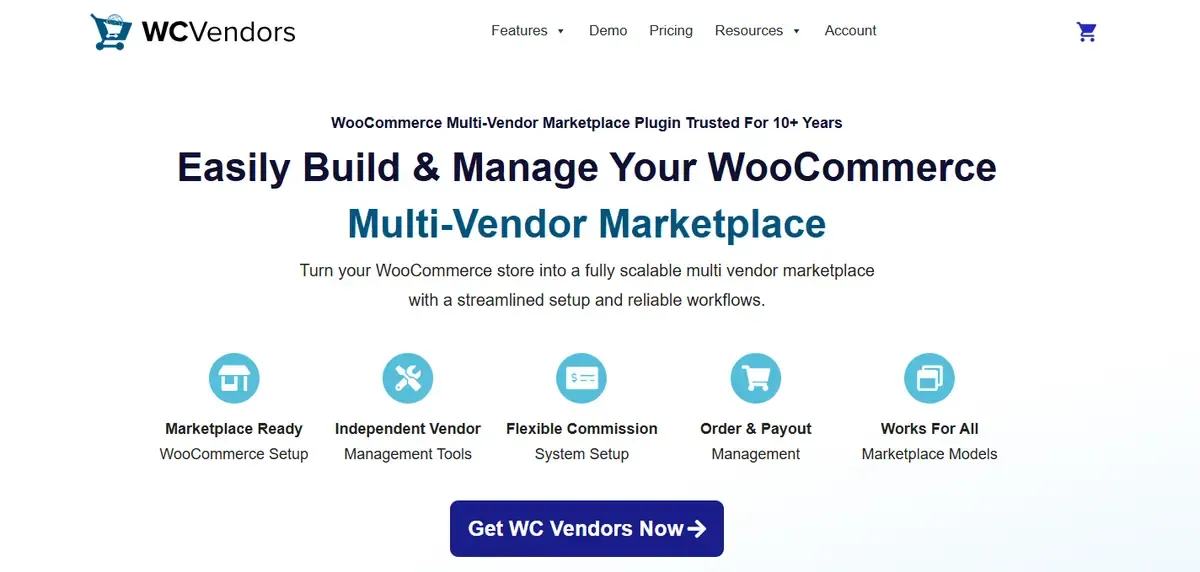
WC Vendors has been in the WordPress ecosystem since 2014, built on a lightweight, developer-friendly codebase that focuses on doing the essentials well.
It’s the most established plugin in this comparison by download count, with over 750,000 free downloads and 10,000-plus active marketplaces.
Key Features
- Flexible commission structures: percentage, fixed, fixed-plus-fee, and tiered models
- Native Stripe Connect payouts built into the base Pro plan
- Flat-rate and table-rate shipping support
- Three paid tiers (Pro, Growth, Business) that layer on subscriptions, vendor memberships, bookings, and auction support as you scale
Pricing: A free version is available. The entry-level Pro plan starts at $99.50/year, making it one of the more affordable genuinely capable paid tiers in this comparison. Note that all licenses are single-domain, with no multisite support at any tier.
Best for: marketplaces that need flexible, granular commission rules without cobbling together extra plugins for basic payout logic.
4. WCFM Marketplace — Best Free Tier

WCFM Marketplace stands out for offering strong core functionality directly in its free tier, making it a favorite for marketplace builders who want to launch without an immediate subscription commitment.
It has one of the highest install counts among free-tier multi-vendor plugins, with over 10,000 active installs and a near-perfect rating on WordPress.org.
Key Features
- Full vendor storefronts and dashboards available in the free version
- Vendor approval workflows and admin-side marketplace controls
- Supports PayPal and Stripe payment gateways
- Automatic payment scheduling, plus payment-on-withdrawal-request options
- Frontend capabilities available through paid extensions if you need deeper customization
Pricing: Core marketplace functionality is free. Frontend and advanced features are available through paid extensions — check WCFM’s official site for current add-on pricing.
Best for: marketplace builders on a tight budget who want a fully functional vendor system without paying for the basics.
5. MultiVendorX — Best for Rental and Booking Marketplaces
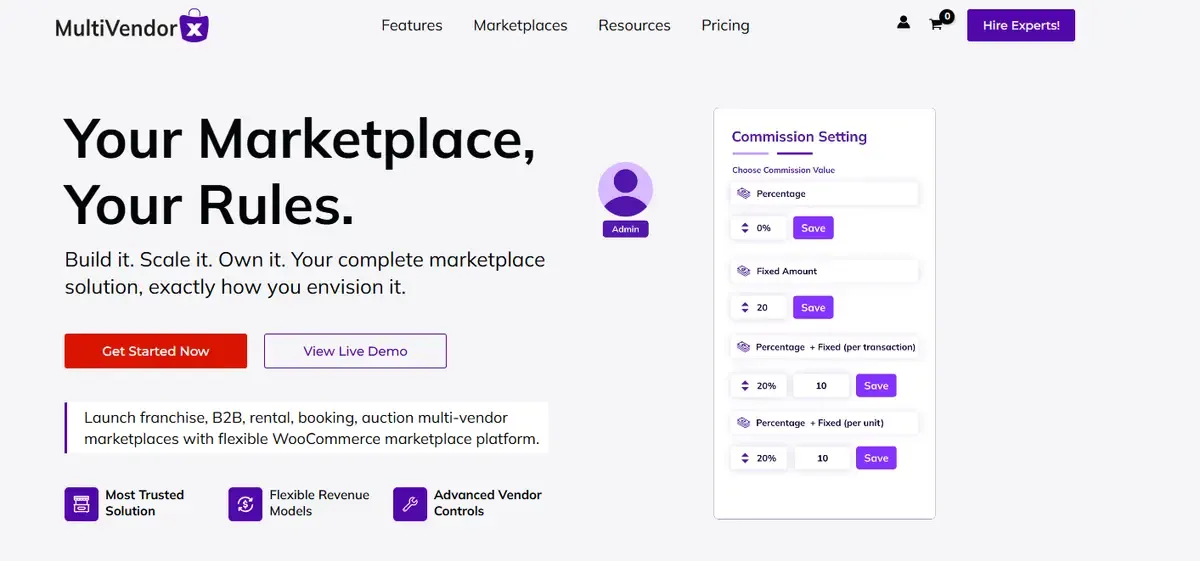
MultiVendorX is a feature-rich multi-vendor plugin built for marketplaces that go beyond standard product sales — particularly rental, booking, and time-based product models.
It gives admins granular control over commissions, supporting product-wise, category-wise, vendor-wise, membership-based, and global commission structures.
Key Features
- Purpose-built workflows for rental and booking-based marketplaces
- Multiple commission types: fixed amount, percentage, product price, and purchase quantity
- Over 100 premium features available through its Pro subscription
- Product add-ons like gift wrapping and special messages alongside primary listings
Pricing: A free core version is available, with Pro subscription pricing plans from $299/year
Best for: marketplace owners running rental, booking, or time-based product models that standard product-only plugins don’t handle well.
Free vs. Paid: What You’re Actually Trading Off
| Plugin | Free tier covers | Where paid kicks in |
|---|---|---|
| StoreEngine | Product management, basic payments, core multi-vendor | Subscriptions, memberships, affiliates, digital licensing |
| Dokan | Core marketplace setup, vendor dashboard | Advanced vendor tools, subscriptions, premium modules |
| WC Vendors | Basic vendor storefronts | Stripe Connect payouts, tiered commissions, bookings/auctions |
| WCFM Marketplace | Full vendor dashboards and admin controls | Frontend customization, advanced extensions |
| MultiVendorX | Core commission and vendor management | 100+ premium features, rental/booking workflows |
The pattern across the category is consistent: basic vendor registration and product listing are usually free everywhere, but payouts, advanced commission logic, and niche product types (subscriptions, bookings, rentals) are where the paid tiers earn their keep. StoreEngine stands out by including affiliate tracking and advanced analytics — features most competitors treat as premium add-ons — inside its core offering.
How to Choose the Right One for Your Marketplace
- Want your core store and multi-vendor marketplace running on one plugin, with affiliates and analytics built in? StoreEngine is the most complete all-in-one option here.
- Want the fastest path from install to a working vendor storefront? Dokan’s guided setup gets you there in under 30 minutes.
- Need flexible, granular commission structures without extra plugins? WC Vendors handles this natively across its paid tiers.
- Working with a tight budget and want a fully functional free marketplace? WCFM Marketplace’s free tier is the strongest in this comparison.
- Running a rental, booking, or time-based product marketplace? MultiVendorX is purpose-built for exactly that use case.
Frequently Asked Questions
What is the best multi-vendor eCommerce plugin for WordPress? For store owners who want their core store and marketplace functionality — including affiliates, analytics, and multi-currency support — in one plugin without stacking add-ons, StoreEngine is the strongest all-in-one pick in 2026. If you need the fastest setup specifically for a vendor marketplace, Dokan is the established leader.
Can I add multi-vendor functionality to an existing WordPress store? Yes. Most plugins in this comparison, including StoreEngine, Dokan, and WC Vendors, are designed to convert an existing single-seller store into a marketplace without rebuilding your site from scratch.
How do commission structures typically work on WordPress marketplace plugins? Marketplace owners usually charge vendors a percentage or fixed amount per sale as their revenue, using models like flat percentage, fixed fee, tiered, or category-based commissions. Plugins like WC Vendors and MultiVendorX support several of these structures natively.
Do multi-vendor plugins support automatic vendor payouts? Many do, though the sophistication varies. WC Vendors includes native Stripe Connect payouts in its base Pro plan, while other plugins may require a separate payout extension — worth checking before you commit to a plugin.
Is a free multi-vendor plugin good enough to launch a marketplace? It depends on your needs. WCFM Marketplace and StoreEngine both offer usable free tiers for core marketplace functionality. However, automated payouts, advanced commission logic, and niche product types like bookings or rentals are typically part of the paid tiers across most plugins.
The Bottom Line
There’s no single “best” multi-vendor plugin in the abstract — only the best one for the marketplace you’re actually building.
But if you want your core store and your vendor marketplace running on one plugin, with affiliates, analytics, and multi-currency support included rather than sold separately, StoreEngine is worth starting with.
It’s built to replace the usual multi-vendor plugin stack with one tool, not add another line item to it.
Ready to build your marketplace? Explore StoreEngine and see what an all-in-one multi-vendor WordPress plugin looks like.