
Tabnine
Privacy-focused AI code completion for enterprise teams
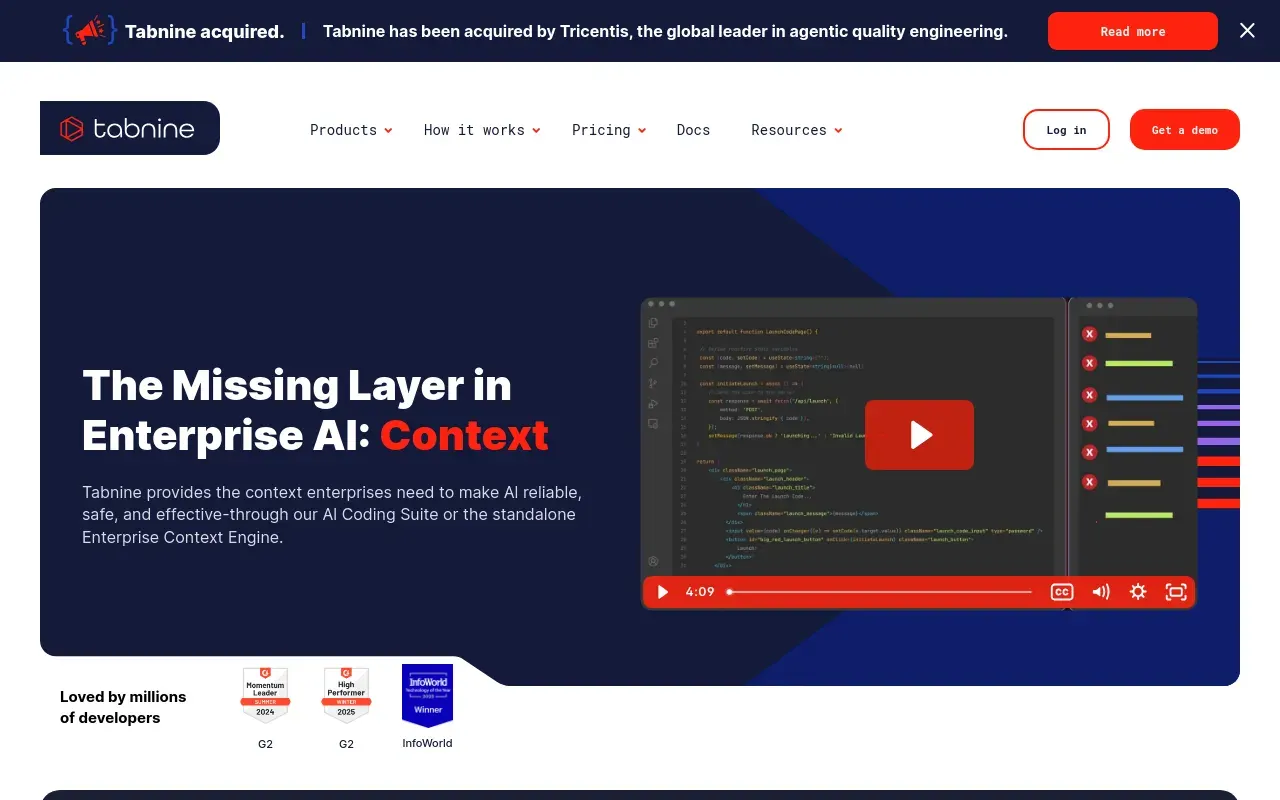
An AI coding assistant built around IP protection and deployment control, offering completions and chat that can run fully self-hosted or air-gapped so no code leaves the customer's network.
Picked for AI Tools for Regulated Industries.
Tabnine built its reputation before the current wave of agentic coding tools, and its pitch has stayed consistent since: AI completion and chat that a security-conscious enterprise can actually deploy, including fully self-hosted or air-gapped installs where no code or prompt ever leaves the customer’s network. That’s a different sales pitch from most of its competitors, who lead with model capability rather than deployment control.
It suits regulated industries, defense contractors and any engineering org whose security policy rules out sending proprietary code to a third-party cloud. The multi-IDE support — VS Code, JetBrains, Eclipse, Visual Studio and more — also makes it a reasonable choice for a large org standardizing on one assistant across a mix of teams and toolchains.
The cost of that focus is that Tabnine isn’t chasing the frontier on agentic capability the way Cursor or Copilot are, and it shows in day-to-day use — completions are solid but less contextually ambitious than newer agent-first tools. Pricing has also gotten less friendly: the free tier is gone, the entry price sits at $39/user/month, and actually standing up a self-hosted deployment is a real infrastructure project, not a toggle in settings.
Features
Private, controllable models
Choose models trained only on permissively licensed code, with an option to run entirely on private infrastructure.
Self-hosted and air-gapped deployment
Enterprise customers can run Tabnine's full stack on-premises or fully disconnected, so no code or prompts leave the network.
Multi-IDE chat and completion
Inline completion and an integrated chat assistant across VS Code, JetBrains, Eclipse, Visual Studio and more.
Test and documentation generation
Produces unit tests and docstrings against existing code, which is the backlog work that never wins a sprint on its own.
Personalisation on your own repositories
Tunes suggestions to a team's actual patterns rather than to whatever is most common on public code.
Code review agent
Checks a change against the organisation's own rules before a human reviewer sees it.
Use cases
- Regulated or security-sensitive teams that can't send code to a third-party cloud
- Standardizing one AI coding assistant across many different IDEs
- Enterprises wanting contractual IP indemnification for AI-generated code
- Generating unit tests for existing code during a coverage push
- Tuning suggestions to a team's own patterns rather than public code
- Documenting a legacy service that nobody currently understands
Compare Tabnine head to head
Side-by-side comparisons, on pricing, platforms and where each one wins.






Looking for something similar?
Other code tools worth comparing against Tabnine.