
Sudowrite
AI writing tool built for fiction authors
An AI writing assistant built specifically for fiction, offering story planning, scene generation and brainstorming tools tuned for novels and short stories rather than general business copy.
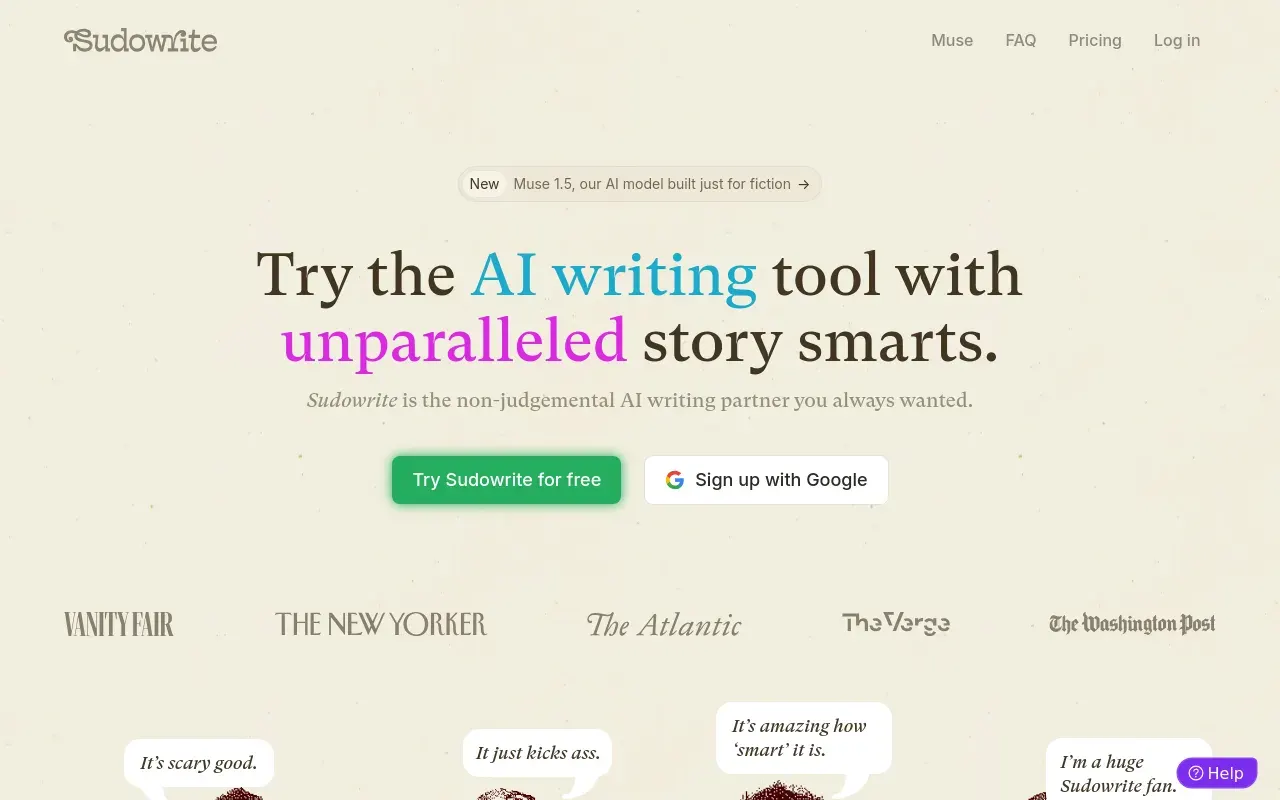
Sudowrite is built for a narrower job than most AI writing tools: helping someone write a novel or short story, not a marketing email or a business report. The Story Bible holds characters, plot points and world details so that generated scenes reference what’s already been established instead of contradicting it a chapter later, which is the kind of consistency problem general chatbots handle poorly over long-form fiction.
It suits working novelists and short-story writers more than casual users — the tools assume you’re deep in a manuscript and need help with a specific stuck scene, a flat character voice, or expanding a sparse draft into something readable, not generating an entire story from nothing. Story Engine can take a rough braindump and turn it into chapter beats and prose, which is useful for outlining but still needs a writer’s judgment to shape into a finished draft.
The credit system is worth understanding before committing: every plan includes the same features, and what differs is purely how many credits are available each month, with longer generations consuming more. That makes it easy to underestimate usage on a lower tier if you’re doing heavy drafting rather than light editing, and there’s no permanent free tier to test the waters — only a limited trial.
Because it’s so specifically tuned for fiction, it’s not a good general writing tool. Business writing, technical documentation or marketing copy fall outside what it’s built for, and using it there wastes the features that make it valuable for novelists in the first place.
Features
Story Bible
Holds characters, plot outlines and world details so generated scenes stay consistent with what's already been established.
Story Engine
Takes a braindump, genre and style and generates chapter beats and full prose from that outline.
Scene expansion tools
Expands a sparse draft with description, dialogue or a different character's perspective on request.
Brainstorm
Generates naming, setting and plot ideas on demand when a writer is stuck rather than staring at a blank page.
Describe, Rewrite and Twist
Targeted tools for one paragraph rather than one general chat box, which is what keeps a revision from rewriting the voice.
Canvas
A plotting board for beats, characters and threads, so structure work happens somewhere other than the manuscript.
Use cases
- Drafting and expanding fiction scenes
- Working through writer's block with generated alternatives
- Planning a novel's structure before drafting
- Rewriting a passage in a different character's voice or tone
- Generating a draft chapter from an outline and an established Story Bible
- Keeping continuity across a long manuscript without rereading earlier chapters
Compare Sudowrite head to head
Side-by-side comparisons, on pricing, platforms and where each one wins.





Looking for something similar?
Other writing tools worth comparing against Sudowrite.