
Vic.ai
Autonomous AI for accounts payable
An AI-first accounts payable platform that reads, codes and approves invoices with increasing autonomy over time, built for finance teams processing high volumes of vendor invoices.
Picked for AI Tools for Regulated Industries.
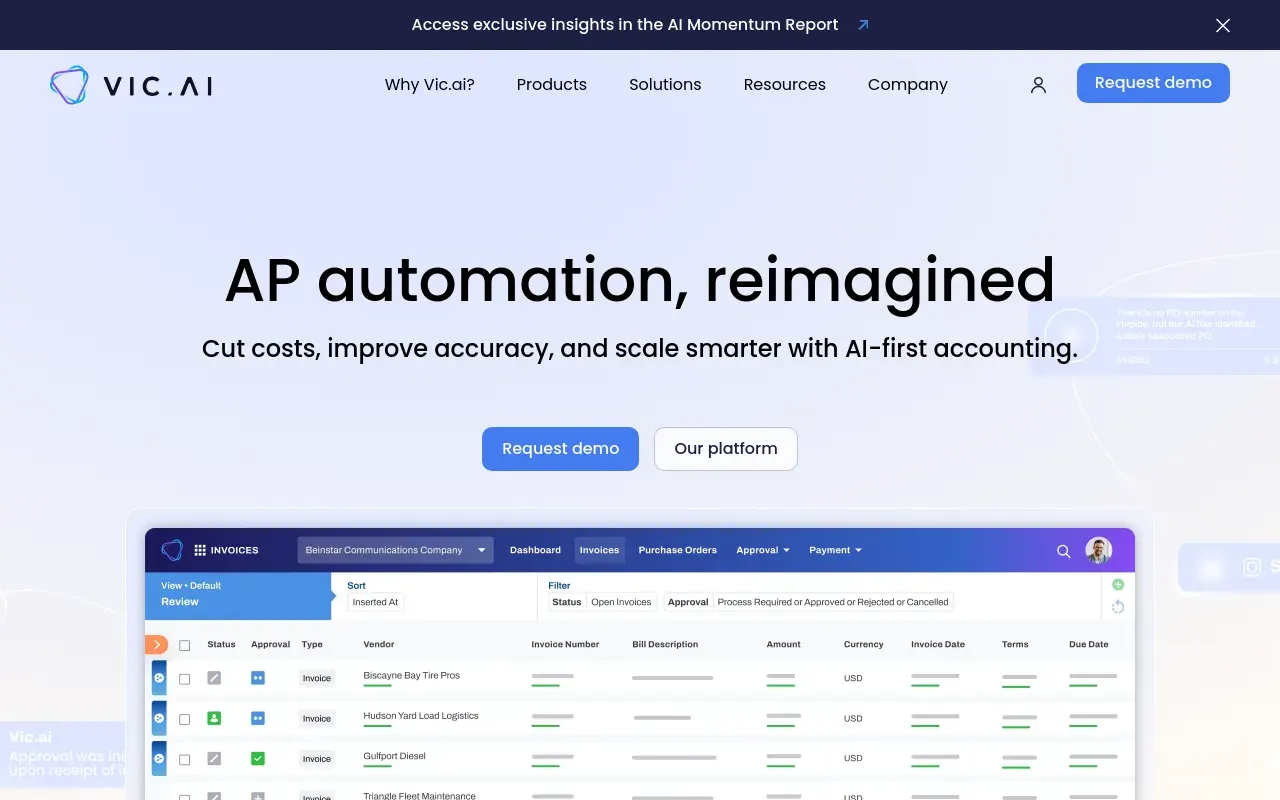
Vic.ai automates the accounts payable workflow — reading incoming invoices, coding them to the right GL account, matching them against purchase orders, and routing them for approval. The pitch is autonomy that compounds: the system is meant to handle a growing share of invoices without a human touching them as it learns a company’s specific coding patterns and vendor relationships.
It’s aimed at finance teams — controllers, AP managers, CFOs — processing enough invoice volume that manual coding is a real bottleneck, particularly in industries like freight, construction and manufacturing where vendor invoice formats vary widely. The PO-matching and exception-flagging features are where most of the practical value shows up: catching a mismatch before payment rather than after is worth more than the time saved on data entry alone.
The honest limitation is that none of this comes with a price tag until you’re in a sales conversation, which makes it hard to evaluate against alternatives without committing time to a demo first. It’s also not a fit for low-volume AP teams — the autonomy gains take real invoice throughput to materialize, and the model needs an onboarding period against a company’s actual coding history before it earns much trust to act without review.
Features
Autonomous invoice processing
Extracts data from incoming invoices and learns a company's coding and approval patterns to process more of them without human touch over time.
PO matching
Automatically matches invoices against purchase orders to catch discrepancies before payment rather than after.
VicPay
Lets finance teams initiate and manage vendor payments directly inside the platform instead of exporting to a separate payment tool.
ERP integrations
Posts to NetSuite, Sage Intacct and similar systems, so automation happens around the ledger a finance team already closes on.
Approval routing
Sends invoices to the right approver based on what the model learned from past decisions rather than from a rules engine somebody maintains.
Spend analytics
Reporting across vendors and categories built from the invoices already flowing through, rather than a separate data project.
Use cases
- Processing high volumes of vendor invoices without adding AP headcount
- Reducing manual coding errors on recurring vendor invoices
- Catching invoice-to-PO mismatches before a payment goes out
- Routing invoices for approval without a rules engine to maintain
- Clearing the AP queue fast enough to stop it delaying the month-end close
- Capturing early-payment discounts that manual processing kept missing
Compare Vic.ai head to head
One side-by-side comparison, on pricing, platforms and where each one wins.