
Consensus
An AI search engine that finds answers in peer-reviewed research
An AI search engine built on top of a database of over 200 million academic papers, returning cited findings and consensus scores instead of blog-post summaries.
Picked for Literature Review & Evidence Kit.
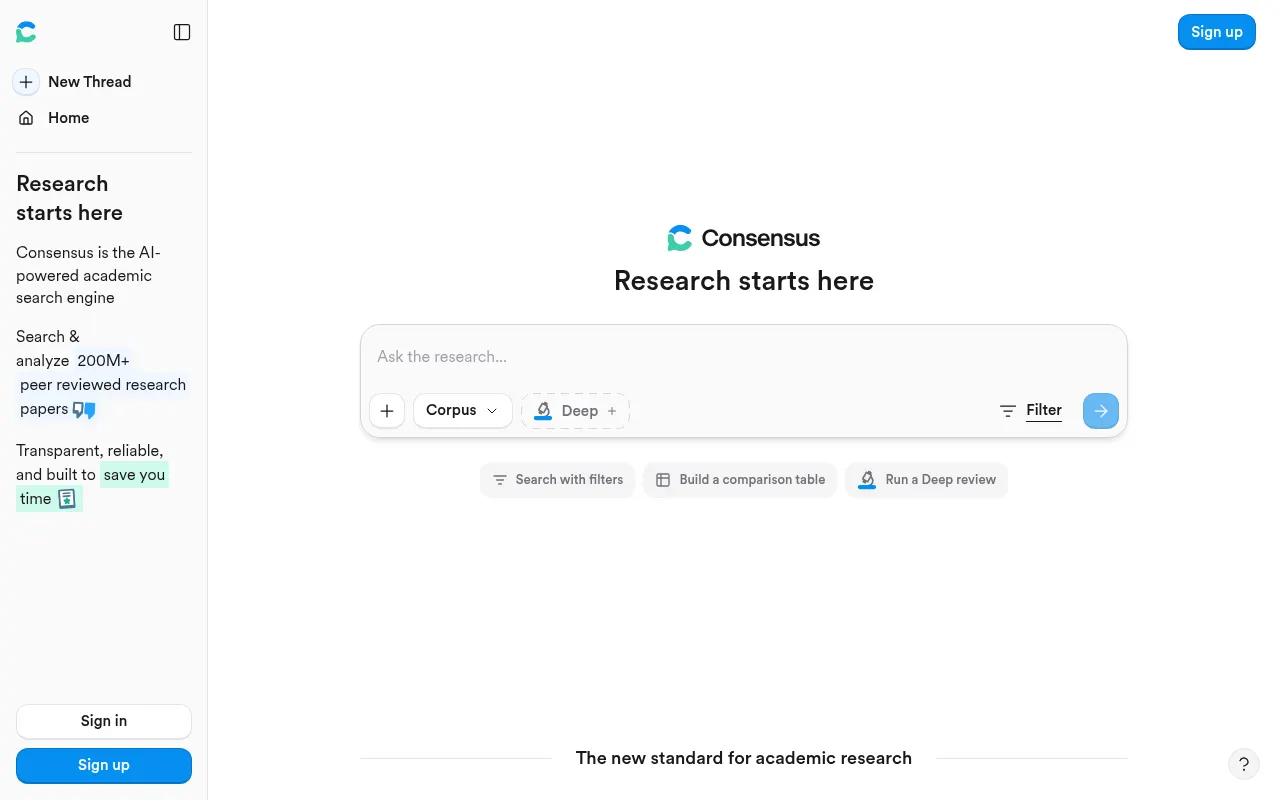
Consensus is a search engine that runs on a database of more than 200 million academic papers instead of the open web. Type a question and it returns a list of matching papers with extracted findings, plus a “Consensus Meter” that gives a rough sense of whether the research leans for, against, or mixed on the question. It’s built to answer things like “does X actually work” without making you read ten abstracts to find out.
It suits students, researchers, journalists and anyone who wants to check a claim against actual published findings rather than a summarized blog post repeating someone else’s summary. The extracted-claims view saves real time over opening each paper individually, and the consensus scoring is useful for spotting when a topic looks more settled in popular writing than it is in the literature.
The catch is coverage: it leans heavily biomedical and life-sciences, so questions in economics, humanities or newer subfields turn up thinner results. It’s also a tool for finding and summarizing papers, not for judging whether any given paper is well-designed — a small, poorly controlled study and a large randomized trial can both show up as “supporting” evidence with equal visual weight, so the summaries are a starting point, not a substitute for reading the actual methodology.
Features
Consensus Meter
Aggregates findings across matching papers into a rough for/against/mixed read, so a contested question doesn't look settled.
Extracted claims
Pulls specific findings out of a paper's text rather than returning just title and abstract, cutting down on abstract-only skimming.
Copilot summaries
A GPT-based synthesis layer that answers a question in plain language while linking every sentence back to a source paper.
Study quality filters
Narrow to study design, sample size, journal quality and recency, so a well-designed trial is not weighed equally against a small observational study.
Study snapshots
A structured card per paper covering population, method and finding, which is the part of an abstract most readers were going to extract anyway.
Ask a paper
Question an individual study directly rather than reading it end to end to find whether it addresses your case.
Use cases
- Checking whether a claim is actually supported by published research
- Scoping a literature review before committing to full-text reading
- Pulling supporting citations for an argument or report
- Filtering to trials and systematic reviews before trusting a finding
- Answering a client or patient question with the citation attached
- Sanity-checking a statistic before repeating it in a report or a talk
Compare Consensus head to head
Side-by-side comparisons, on pricing, platforms and where each one wins.




Looking for something similar?
Other research tools worth comparing against Consensus.